

Phil Heath is known as “The Gift” — and for seven straight years, nobody in bodybuilding could beat him. 🏆
Before the trophies, though, he was a college basketball player who had barely touched a barbell. This is the story of how that athlete became one of the strongest and most dominant champions the sport has ever seen.
For his full life story, see the Phil Heath biography — this feature focuses on his strength, his training, and where he stands in 2026.
From the Court to the Gym 🏀
Phillip Jerrod Heath was born in Seattle, Washington, on December 18, 1979. At Rainier Beach High School he played shooting guard on a team that won the state title in 1998.
He then went to the University of Denver on an athletic scholarship, playing Division I basketball and studying business administration. Bodybuilding was not yet on his radar.
That changed in 2002, when he began training seriously. His rise was startlingly fast — within a few years he went from newcomer to national champion.
A Remarkably Fast Rise 📈
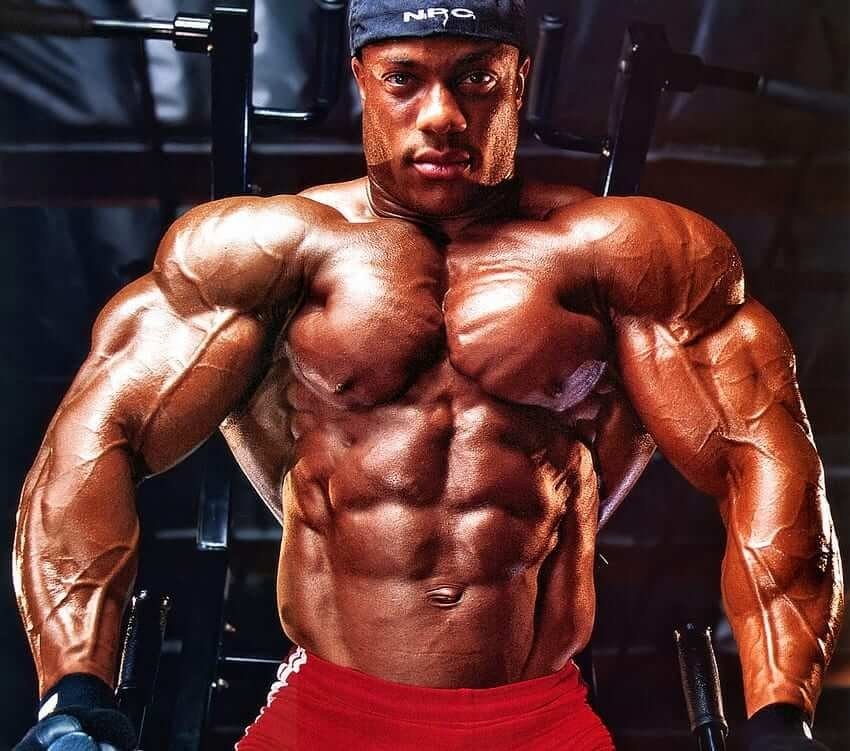
Heath won his first contest, the 2003 NPC Northern Colorado show, taking the light-heavyweight class and the overall title. The following year he won the NPC Colorado State heavyweight title and overall.
Then came the breakthrough. In 2005 he won the NPC Junior Nationals and the NPC USA Championships, heavyweight and overall both times — earning his IFBB pro card.
As a rookie professional in 2006, he won his first two pro shows back to back: the Colorado Pro and the New York Pro. Few debut seasons in bodybuilding history have been that emphatic.
Seven Straight Mr. Olympia Titles 🏆
Heath’s Olympia debut came in 2008, when he finished third — an outstanding result for a first-timer. He placed fifth in 2009 and second, behind Jay Cutler, in 2010.
In 2011 he beat Cutler to win his first Mr. Olympia. He then defended the title every year through 2017 — seven consecutive Sandow trophies.
That total ties Arnold Schwarzenegger’s seven Olympia wins. It does not beat the record: Ronnie Coleman and Lee Haney each won eight.
His great rival through the reign was Kai Greene, runner-up in 2012 and 2014, in a rivalry that defined the era. Read more about Greene in the Kai Greene biography.
One Arnold Record, Stated Plainly
Heath never won the Arnold Classic in Ohio. His best finishes there were second place, in 2008 behind Dexter Jackson and in 2010 behind Kai Greene, and fifth in 2007.
His Arnold victory came at a different event: the Arnold Classic Europe, which he won in 2013, the same year as his third Olympia title. He has no Arnold Classic UK result — that event began after his competitive peak, and he has not competed there.
Alongside the Olympias, he also won the Sheru Classic in 2011 and 2012 and the 2008 Iron Man Pro. His full contest record is a short list of near-misses followed by total dominance.
How He Trained: The FST-7 Method 💪
Heath worked for much of his championship run with coach Hany Rambod, using Rambod’s FST-7 system. The idea was simple to describe and brutal to do.
After the main work for a muscle group, the session finished with seven sets of a final exercise, done with short rests. The goal was maximum pump and fatigue, stretching the fascia around the muscle to encourage growth.
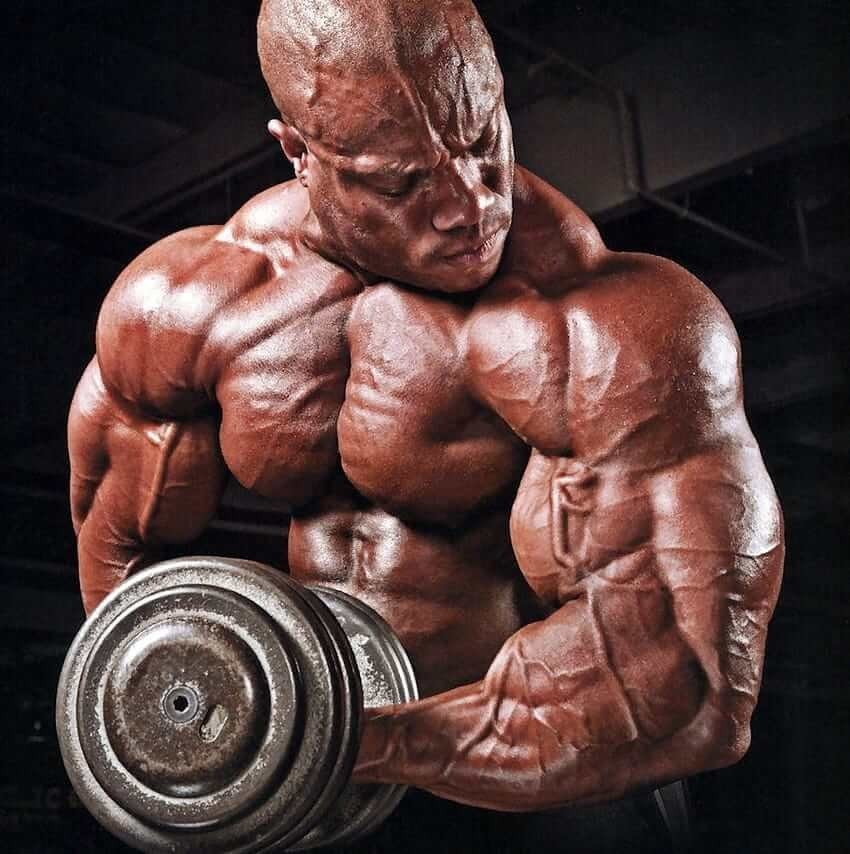
His training favoured high-volume, high-rep work and plenty of machines, but barbell basics stayed in the programme. He trained for shape and fullness, not for powerlifting totals.
That is an important distinction. Heath was a bodybuilder who happened to be very strong — not a strength athlete who happened to look the part.
How Strong Was Phil Heath, Really?
Because he never competed in powerlifting, there are no official competition lifts to quote. The numbers below are Heath’s own statements about his gym lifting, not verified records.
Speaking with Shannon Sharpe, Heath said he belonged to the “1,500-pound club” for his combined squat, bench press and deadlift. He put his bench press at 505 pounds and his squat at 495 pounds for eight to ten reps.
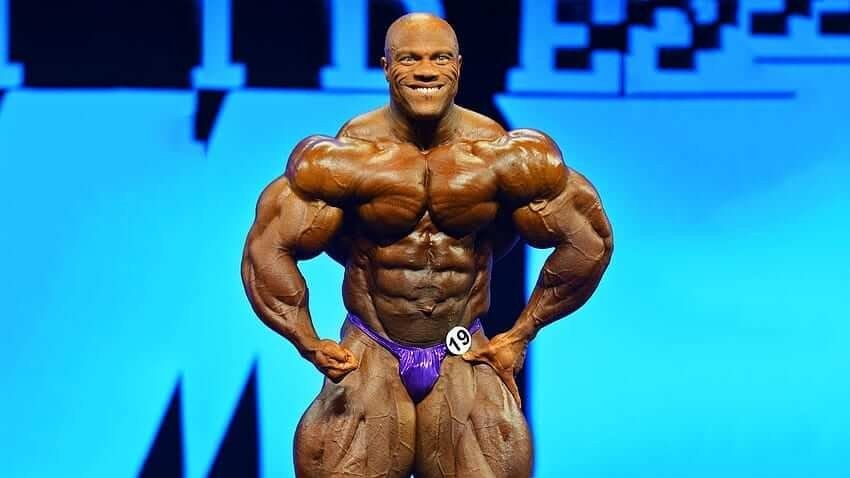
Those are serious numbers by any standard, and they help explain why the “he only won on genetics” argument never held up. Genetics gave him his shape; years of heavy, disciplined training built the rest.
Comparisons with other champions’ gym lifts are not published here, because they cannot be verified on equal terms. What can be said is that Heath’s strength supported his physique — it was never separate from it.
The 2018 Loss and the 2020 Comeback
By 2017, abdominal hernia problems were already affecting Heath’s midsection control on stage. He won his seventh title that year, but the issue was becoming impossible to hide.
In 2018, Shawn Rhoden arrived with a tighter, more streamlined physique and took the title. Heath finished second, and his seven-year reign was over.
Heath then had further abdominal surgery, sat out the 2019 Olympia, and returned in December 2020 chasing a record-tying eighth title. He finished third, behind champion Mamdouh “Big Ramy” Elssbiay and runner-up Brandon Curry.
That 2020 Olympia remains his last appearance on a competitive bodybuilding stage.
Phil Heath in 2026: Where He Stands Now 🌟
Heath has not competed since 2020. He has never issued a formal retirement announcement, but his own words have closed the door on a comeback.
On Jay Cutler’s Cutler Cast podcast in March 2025, asked about the returning Masters Olympia, he said plainly: “I’m not gonna compete. There’s no Masters Olympia for me.” He has, however, hinted at coaching — naming even his old rival Kai Greene as a possible client.
Off stage, he stays visible in the sport as a commentator and ambassador, and he remains active in the gym at a lighter, more sustainable size than his competitive peak.
His business history is worth stating accurately. He launched Gifted Nutrition in July 2014 while still Mr. Olympia — the first reigning champion to run his own supplement company — but he parted ways with it in July 2016. Any claim that he launched it recently, or still runs it, is out of date.
Two recent honours round out the picture: the documentary “Breaking Olympia: The Phil Heath Story” was released in March 2024, and he was inducted into the International Sports Hall of Fame in October 2024.
Frequently Asked Questions ❓
How many Mr. Olympia titles did Phil Heath win?
Seven, consecutively, from 2011 to 2017. That ties Arnold Schwarzenegger’s seven; the record of eight belongs jointly to Lee Haney and Ronnie Coleman.
Did Phil Heath ever win the Arnold Classic?
He won the Arnold Classic Europe in 2013, but never the Arnold Classic in Ohio, where his best result was second place (2008 and 2010). He has no Arnold Classic UK result.
Is Phil Heath competing in 2026?
No. His last contest was the 2020 Mr. Olympia, where he placed third, and in March 2025 he ruled out a Masters Olympia comeback. He remains involved in bodybuilding as a commentator, ambassador and coach-in-waiting.
What was Phil Heath’s training style?
High-volume, high-rep bodybuilding work under coach Hany Rambod, built around the FST-7 system — seven short-rest sets to finish a muscle group. For his day-to-day approach, see the Phil Heath diet plan and workout routine.
Why is he called “The Gift”?
The nickname refers to his natural structure — narrow joints, long muscle attachments and full muscle bellies — which gave his physique its famous round, three-dimensional look. It was a starting point, not the whole story.
The Takeaway ✨
Phil Heath’s legacy is not just seven Sandows. It is the speed of his rise, the completeness of his dominance, and the honesty of his ending.
He went from college basketball to the top of bodybuilding in under a decade, held it for seven years, and walked away when his body told him the time had come. Few champions manage all three.
For the full story of his life and career, start with the Phil Heath biography — and for the man whose record he chased, the Arnold Schwarzenegger biography.