

One hundred push-ups in a single day sounds simple. 💪
The catch is in the wording: this challenge is about a daily total, not about doing all 100 in one unbroken set.
That distinction matters, because it changes how hard the challenge is, how you split it up, and who it suits.
Not the same as 100 in a row — please read this first ⚠️
This article is about reaching 100 push-ups across a whole day, in as many small sets as you need.
It is NOT the same as doing 100 push-ups in a row without stopping. That is a different, much harder goal, and it has its own guide: our 100 Pushups Challenge.
If your goal is one unbroken set of 100, read that guide instead. If your goal is a daily habit built from smaller sets spread through the day, you are in the right place.
What “100 a Day” Actually Means 🏋️
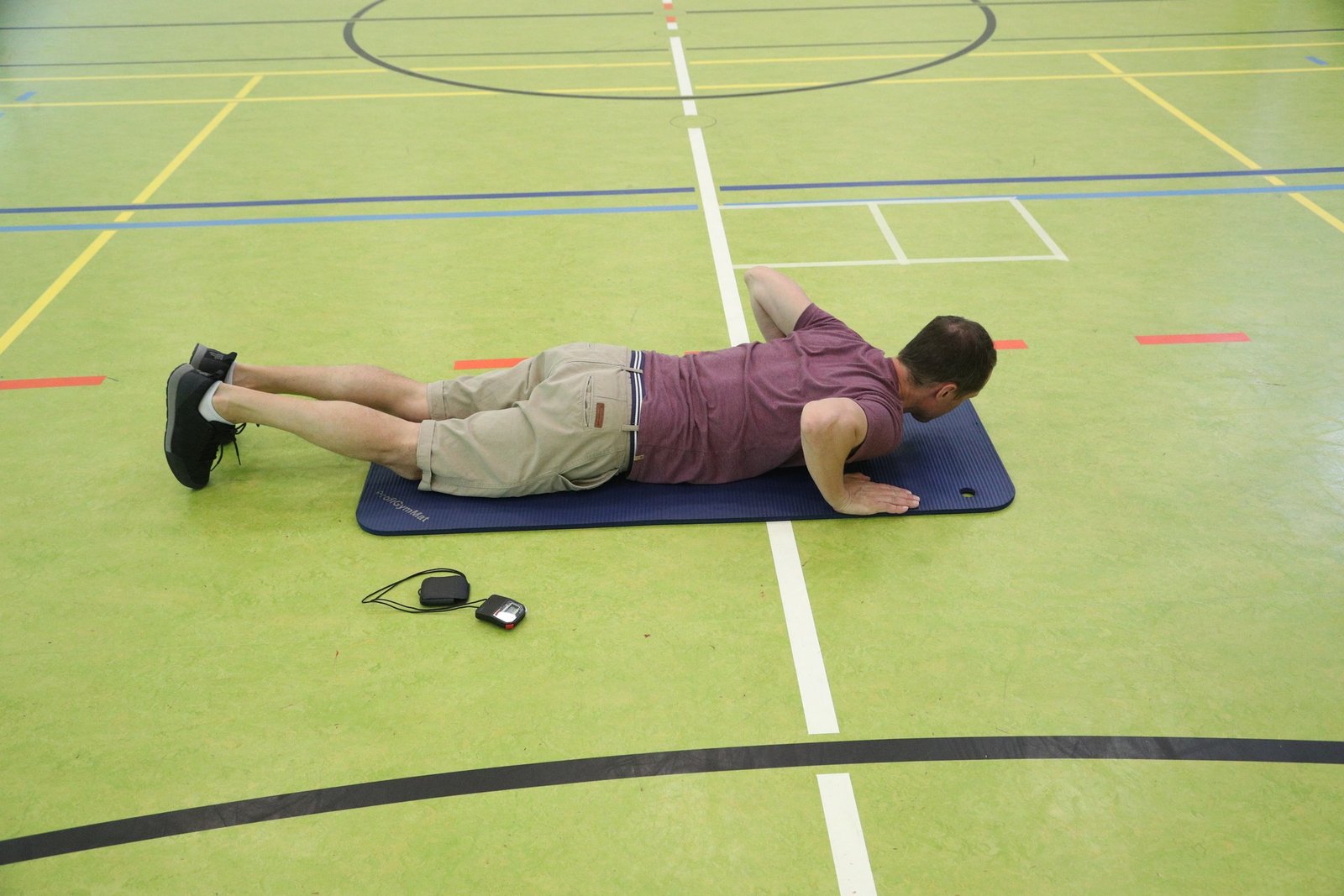
A man at the low point of a standard floor push-up on a mat. Photo: Uzltt123 / Wikimedia Commons
In the usual version, you complete 100 push-ups before the day ends. How you divide them is up to you.
Some people do a few sets in the morning and finish the rest in the evening. Others spread small sets through the day, whenever they have a spare few minutes.
Neither approach is more “real” than the other. The total is the challenge here, not the size of any single set.
For the wider picture on what push-ups do in general, see our guide to the benefits of doing push-ups rather than a repeated list here.
What it can honestly build — and what it cannot 🌱
Done regularly, a daily push-up habit is most reliable at building two things: muscular endurance and a habit itself.
Endurance means the same number of reps starts to feel easier. Your chest, shoulders, triceps and core get steadier at repeated pressing work, and the movement feels less of a struggle.
For someone fairly new to training, some strength and muscle gain is realistic at first, because almost any regular pressing work is a new stimulus.
What it does NOT guarantee is a particular body shape, a set amount of muscle, or weight loss. Those depend on far more than one exercise — your overall training, food, sleep and starting point.
If you want the straight version of the “ripped” question, read what push-ups can and cannot do alone before expecting a transformation.
Split the 100 Across the Day 🧩

A large group of people doing push-ups together in a gymnasium. Photo: U.S. Navy / Wikimedia Commons
Trying to force all 100 in one go is the fastest way to wreck your form. Tired reps with sagging hips and flared elbows teach little and tire your joints.
Splitting the total is the normal way people actually finish this challenge. Common splits include five sets of 20, ten sets of 10, or four sets of 25.
Pick a split you can do with good form, with short rests between sets. If the last reps of a set look nothing like the first ones, that set was too big.
Leaving a few reps “in the tank” on each set is not cheating. It is how most people keep their form honest across a high daily total.
Keep a simple tally — a note on your phone is enough. Guessing at the end of the day is how totals quietly drift.
Scale It Down Before You Scale It Up 📉

A woman doing an incline push-up with her hands on a rock outdoors. Photo: PTPioneer / Wikimedia Commons
One hundred floor push-ups is a big jump if you cannot yet do a comfortable set of floor reps. Scaling down is not a failure — it is how the total stays doable.
An incline push-up, with your hands on a raised surface such as a bench, step or sturdy rock, is lighter than a floor push-up because more of your weight stays over your feet.
Our incline push-up guide explains the setup in full, and our push-up variations guide covers the other versions without repeating them here.
Knee push-ups and wall push-ups are also legitimate easier steps, and they are described in words only in this article.
Transparency note: no photo in this package shows a wall push-up or a knee push-up, so neither version is pictured here. Please do not caption any image in this article as a wall or knee push-up.
If you are new to push-ups altogether, start from our beginner’s guide to daily push-ups instead of jumping straight to 100.
Recovery, Plateaus and When to Stop 🛑

A woman doing an incline push-up with her hands on a raised wooden surface indoors. Photo: Shixart1985 / Wikimedia Commons
Here is the honest trade-off in this challenge: it has no built-in rest day. The same pressing pattern, every day, is exactly what can irritate shoulders, wrists and elbows over time.
Soreness at the start is common when the volume is new. But pain that changes how you move, sharp joint pain, or soreness that never settles is a stop signal, not a badge of toughness.
If that happens, stop the challenge, rest, and get advice from a clinician or qualified coach before carrying on. Pushing through joint pain to protect a streak is a bad trade.
Rest is part of training, not the opposite of it. Some people do better on an every-other-day version, or on a lower daily total with rest days built in.
That is a sensible modification, not a failed challenge. A habit you can keep beats a streak that injures you.
Expect a plateau, too. Once 100 easy reps feel routine, the same total stops being a new stimulus, and progress slows.
That is normal, and it is not fixed by endlessly adding more easy reps. Harder variations, slower lowering, or a different programme are the usual next steps — gradually, and only with good form.
Push-ups also only train pressing. Without pulling work for the upper back, a press-only routine can leave your programme lopsided, so think about balance across the week, not just the daily number.
Who should not jump straight in 🚫
This daily total is a poor starting point if you already have shoulder, wrist or elbow pain, a recent upper-body injury, or a condition that affects your joints.
The same applies if you cannot yet do a small number of good-form reps. A daily target of 100 will not fix weak form — it will just repeat it 100 times.
In any of those cases, check with a clinician or qualified coach first, and consider a lower total or an easier version. There is no deadline on this challenge worth an injury.
For a realistic sense of timing, with no promised date, see how long push-up results honestly take.
FAQs ❓
Is this the same as the 100 Pushups Challenge?
No. That challenge aims for 100 push-ups in a row. This article is about 100 push-ups in total across a day, split into sets.
Will 100 push-ups a day build muscle?
It can build endurance and, for beginners, some strength and muscle at first. It does not guarantee a particular physique, and once the reps feel easy, the same total alone tends to plateau.
Do I have to do them every single day?
No. The classic version is daily, but rest days and every-other-day versions are sensible modifications, especially if your joints complain or your form falls apart.
What if I cannot do 100 yet?
Then 100 is not your starting point. Use an easier version, a smaller daily total, or the beginner’s guide linked above, and build up only when your form stays clean.
When should I stop?
Stop if you feel sharp pain, joint pain that lingers, or pain that changes how you move — and get advice from a clinician or qualified coach before restarting.
The bottom line is simple: treat 100 a day as a habit experiment, not a promise. Split it, scale it, rest when you need to, and let good form — not the streak — decide whether it stays in your routine. 💪