

How we chose: This is a research-based guide, not a hands-on test. We compared manufacturer specifications, expert reviews and verified buyer feedback, then filtered everything through one question: would a 70-year-old with a sore knee feel safe using this on day one? Equipment that needs an app account or perfect balance did not make the cut.
A quick safety note: if you have a heart condition, a recent joint replacement, balance problems or you are returning to exercise after surgery or a long break, check with your doctor or physical therapist before starting. That one conversation decides which of these six picks is right for you — and which to skip for now.
Why the Right Equipment Matters More After 60
Staying strong after 60 is not about chasing personal records. It is about carrying the shopping in one trip, getting up from a low chair without using your arms, and trusting your legs on the stairs.
The best senior equipment is not the most high-tech. It is the kind that feels safe enough to use every day — because the workout you actually do beats the impressive one you avoid. That is why this guide is organised differently from our general best exercise machines for home roundup: every pick below is seated, supported, low-impact or grab-and-go simple, with controls you can read and reach without bending, squinting or downloading anything.
What “Senior-Friendly” Actually Means
Before the picks, here is the checklist we judged them against: an easy on, easy off (step-through frame, a seat you sit down into, or no mounting at all); something to hold (long handrails, a backrest, handles within reach); low impact (smooth motion, no pounding on knees, hips or ankles); simple controls (big numbers, few buttons, a quick-start option — no subscription, no account); honest capacity (a stated weight limit with real headroom, on a base that does not wobble); and realistic setup (little or no assembly).
The 6 Best Home Exercise Equipment Picks for Seniors at a Glance
| Product | Type | Why it suits seniors | Approx. price |
|---|---|---|---|
| Schwinn 230 Recumbent Bike | Recumbent exercise bike | Step-through frame, supportive seat with backrest, gentle on knees | ~$500–600 |
| Redliro Walking Treadmill for Seniors | Walking treadmill | Full-length handrails both sides, slow start, big simple display | ~$290–390 |
| Cubii JR1 | Seated under-desk elliptical | Used from your own chair — nothing to climb onto | ~$170–230 |
| Amazon Basics Neoprene Dumbbell Set (20 lb) | Light dumbbells with stand | Soft grip kind to hands, weights kept off the floor | ~$35–45 |
| Fit Simplify Resistance Loop Bands | Resistance bands (set of 5) | Smooth, joint-friendly resistance, seated or standing | ~$10–13 |
| ProsourceFit Exercise Balance Pad | Foam balance pad | Gentle balance practice beside a counter; doubles as knee cushion | ~$25–30 |
1. Schwinn 230 Recumbent Bike — Best Overall for Seniors
Who it’s for: anyone who wants proper cardio at home without stressing knees, hips or back — and without climbing onto a high saddle.
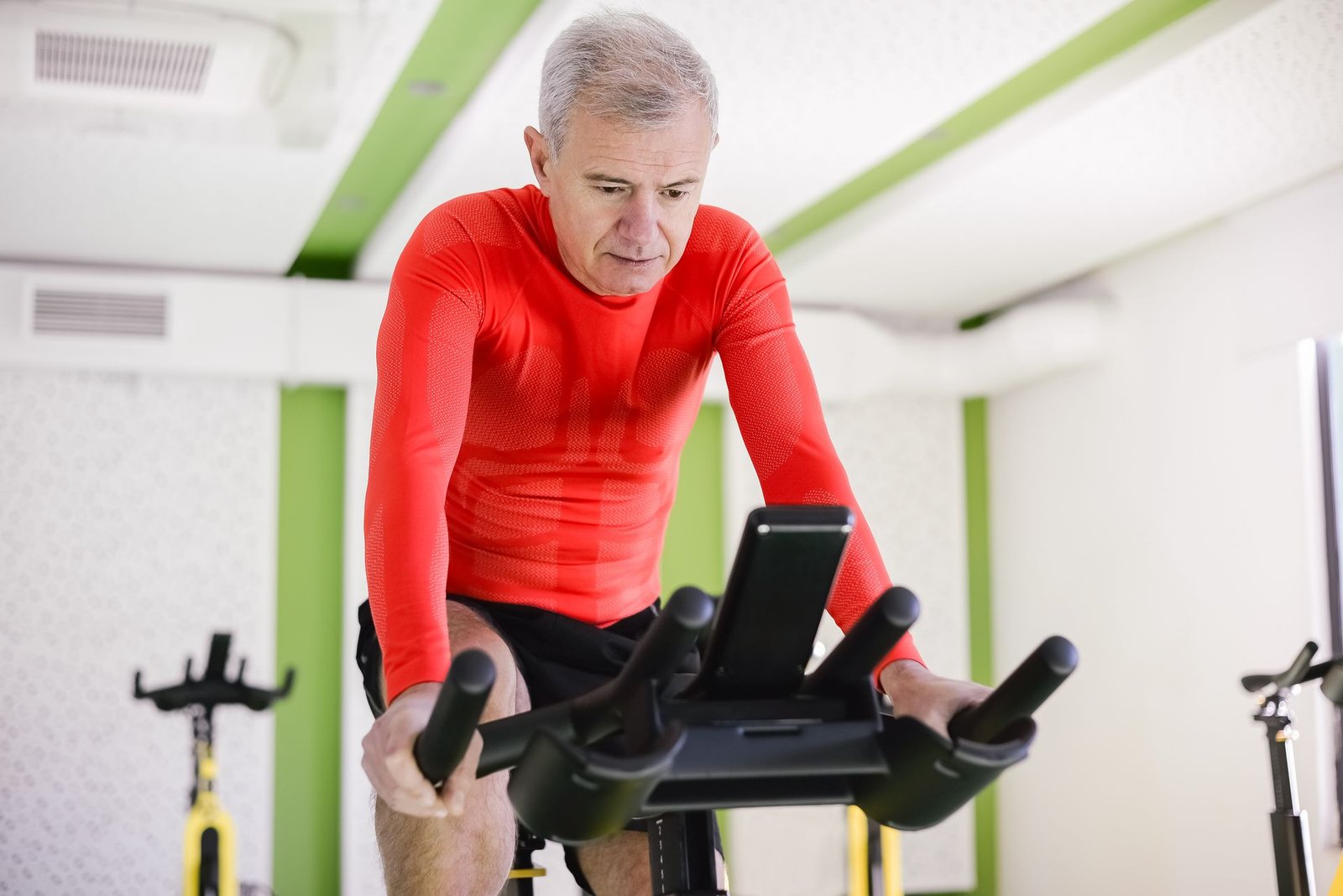
A recumbent bike is the friendliest full-size machine for older joints. You step through the low frame rather than over it, sit down into a wide, chair-like seat with a ventilated backrest, and pedal with your legs out in front. No balancing, nothing to fall from.
The 230 gives you 16 magnetic resistance levels — smooth and quiet, with no jolts as effort changes — plus 13 built-in programs, though most seniors will live on quick-start and the big resistance buttons. The seat slides on a rail and locks with a lever you can reach while seated, so different heights can share it.
Specs that matter: step-through frame; 300 lb capacity; 5.5-inch LCD (speed, distance, time, calories); about 64 × 27 inches; 10-year frame warranty.
Pros
- Chair-style seat with back support — comfortable for 20–30 minute rides
- Very low impact; a common choice for knee-friendly cardio
- No subscription or account needed; Bluetooth tracking is optional
Cons
- The display is not backlit — set it up in a well-lit spot
- Assembly takes one to two hours and is a two-person job
Price: around $500–600.
Check the price of the Schwinn 230 on Amazon
2. Redliro Walking Treadmill for Seniors — Best for Supported Walking
Who it’s for: walkers who want a daily indoor walk with something solid to hold the whole way.
Most treadmills are built for runners and happen to allow walking. This one is the opposite. Long handrails run down both sides of the belt for its full length, so support is always under your hands — not just at the front. Speed buttons sit in the handrail itself, and the belt starts at a gentle 0.5 mph.
The 5.5 mph top speed is a brisk walk — deliberately capped, because this machine is about steady, confident walking. A safety key clips to your clothing and stops the belt if you stumble, and a manual 0–2% incline adds a little hill when you are ready.
Specs that matter: full-length dual handrails; 0.5–5.5 mph; 300 lb capacity; cushioned belt about 41.5 × 16 inches; large dual display (speed, time, distance, calories, heart rate); folds up on transport wheels.
Pros
- Continuous handrail support — the single biggest confidence feature here
- A mute button silences the beeps — a small thing your household will thank you for
- Minimal assembly; mainly attaching the handrails and console
Cons
- The 16-inch belt is narrower than a full-size treadmill — walk centred, eyes ahead
- Walking only: the 5.5 mph ceiling is by design, but runners should look elsewhere
Price: around $290–390.
Check the price of the Redliro Walking Treadmill on Amazon
3. Cubii JR1 — Best Seated Elliptical (Nothing to Climb Onto)
Who it’s for: anyone whose balance rules out standing equipment, or who wants gentle movement woven into the day — reading, watching TV or working at a desk.
The Cubii JR1 is a compact elliptical that sits on the floor in front of your favourite chair. You stay seated the whole time, pedalling in a smooth, low-impact ellipse. Because you never mount, dismount or stand on it, the fall risk during the workout itself is about as low as equipment gets — it is exercise that starts from a chair.
Eight resistance levels turn with a simple dial, and a small display counts strides, distance and calories. One practical detail: use it on a firm, non-slip floor with a sturdy chair — Cubii includes wheel stoppers for chairs that roll.
Specs that matter: seated use only; about 23 × 18 × 10 inches and roughly 25 lb; 300 lb seated user limit; no power cord (display runs on a small battery); assembly is just the pedals.
Pros
- The safest possible format — exercise that starts from a chair
- Genuinely low impact; kind to knees, ankles and hips
- Small and light enough to slide under a desk or beside a sofa
Cons
- Light intensity — it builds daily movement and circulation, not hard cardio fitness
- Needs the right chair: stable, with enough knee clearance under the desk
- Calorie readouts on small devices are estimates — treat them as motivation, not measurement
Price: around $170–230.
Check the price of the Cubii JR1 on Amazon
4. Amazon Basics Neoprene Dumbbell Set (20 lb, with Stand) — Best Light Weights
Who it’s for: seniors starting strength work, where 2, 3 and 5 lb in each hand is exactly the right place to begin.
Muscle is what keeps you independent, and light dumbbells are the simplest way to train it: sit-to-stands holding a pair, slow curls, presses seated in a sturdy chair. This set covers the weights most older beginners actually use — pairs of 2, 3 and 5 lb (20 lb total) — not a heavy rack you will never touch.
Two details make it senior-friendly rather than just cheap. The neoprene coating is soft and grippy, which matters if arthritis weakens your grip. And the stand keeps every dumbbell at knee height in one tidy place — no weights on the floor as a trip hazard, no bending down to fetch them.
Specs that matter: 3 pairs (2, 3, 5 lb); colour-coded with the weight printed on each end; hex shape so they cannot roll; stand included (a few screws to assemble).
Pros
- The right weight range for starting out — no intimidating iron
- Comfortable grip for sensitive or arthritic hands
- Stand keeps the workout corner tidy and trip-free
Cons
- 5 lb per hand is a ceiling, not a forever weight — stronger users will outgrow it (our best dumbbells for home guide covers the step up)
- The stand needs simple self-assembly out of the box
Price: around $35–45.
Check the price of the Amazon Basics Dumbbell Set on Amazon
5. Fit Simplify Resistance Loop Bands (Set of 5) — Best Budget Strength Pick
Who it’s for: seniors who want strength training that is gentle on joints, needs zero setup, and costs less than a pizza.
Resistance bands pull smoothly through the whole movement, with no weight to drop on a foot and no jolting a sore shoulder. This set of five flat loop bands runs from extra-light (about 2–4 lb of resistance) to extra-heavy (25–30 lb), each colour-coded with its level printed on it, so you always know which one you picked up.
For seniors, the sweet spot is the three lightest bands: seated leg presses, standing hip work holding a chair back, gentle rows and shoulder exercises. The included guide shows dozens more, and the set lives in a carry bag in a drawer.
Specs that matter: 5 resistance levels, roughly 2–30 lb; natural latex, 12 × 2 inches each; printed, colour-coded levels; instruction guide and carry bag included; no assembly.
Pros
- Smooth resistance that is forgiving on knees, shoulders and elbows
- Works seated or standing — pair it with a sturdy chair for support
- Costs almost nothing and stores in a drawer
Cons
- Made of latex — not suitable if you have a latex allergy
- Bands can roll or bunch on bare legs during some exercises; over light clothing is better
- Inspect before each use and replace any band with nicks or tears — a snapped band is no fun
Price: around $10–13 for the set of five.
Check the price of Fit Simplify Bands on Amazon
6. ProsourceFit Exercise Balance Pad — Best for Balance Practice
Who it’s for: seniors who feel steady on flat ground and want to carefully train balance — the skill that protects you from falls — plus anyone who wants a kinder surface for kneeling exercises.
This is a thick slab of soft, non-slip foam (about 15.5 × 12.75 inches, 2.25 inches thick). Standing on it makes your ankles and core work a little harder to keep you level — which is exactly how balance improves. Start with both feet, for short holds, next to a kitchen counter or heavy table you can grab. That support within arm’s reach is part of the exercise, not cheating.
Off-duty, the same pad cushions knees during floor stretches. If stiff, achy joints are part of the picture, our research on the best joint supplements explains what the evidence actually supports — but no supplement replaces the balance practice itself.
Specs that matter: TPE foam, non-slip surface; about 15.5 × 12.75 × 2.25 inches; weighs under 1 lb; wipes clean; no assembly.
Pros
- Trains balance and ankle strength in a few minutes a day
- Soft landing for knees during floor work
- Progression is built in: flat floor first, then the pad, always beside support
Cons
- Do not use it standing if your balance is poor or you are home alone — seated and supported work comes first
- The small size suits two feet side by side; a larger 15 × 18.75-inch version exists if you want more room
Price: around $25–30.
Check the price of the ProsourceFit Balance Pad on Amazon
Safety First: Setting Up a Senior-Friendly Workout Corner
The equipment is only half the story. A few minutes spent on the space around it removes most of the risks:
- Put machines on the ground floor, on a firm, level surface — never on a rug that can slide. A thin non-slip mat underneath keeps a bike or treadmill planted and protects the floor.
- Keep support within reach. Set up next to a wall, counter or heavy, stable chair, with about three feet of clear space around the equipment for getting on and off.
- Clear the trip hazards. Cords run along walls, never across walkways. Dumbbells live on their stand, bands in their bag, nothing is stored on the treadmill belt — and a phone stays within arm’s reach while you exercise, especially if you live alone.
- Light it like you mean it. Bright, even lighting matters more than any feature on this page — you should read the display without leaning in.
- Wear shoes, not socks. Supportive, non-slip footwear for everything, including the treadmill. Socks on a moving belt are an accident looking for a place to happen.
- Warm up gently, and know the stop rules. Start every session easier than you think you need to. Chest pain, dizziness, unusual breathlessness or a joint that suddenly complains are all full stops — end the session and, if symptoms persist, seek medical advice.
Frequently Asked Questions
What is the safest type of exercise equipment for seniors?
Seated equipment is the safest starting point — there is nothing to balance on or fall from. A recumbent bike like the Schwinn 230 is the best all-round choice for cardio; a seated elliptical like the Cubii JR1 is gentler still. Which suits you depends on your mobility and your doctor’s advice, not on willpower.
I have a knee or hip replacement. What should I avoid?
Get clearance from your surgeon or physical therapist first — post-replacement timelines are individual. Recumbent cycling is commonly used in rehab because it is seated and low-impact, but range-of-motion limits after hip surgery are personal. Avoid high-impact work, deep knee bending under load, and standing balance work on unstable surfaces until your care team says otherwise.
How much exercise should a senior aim for each week?
Public-health guidelines for older adults generally suggest building toward about 150 minutes of moderate activity a week, plus strength work on two days and balance practice if you are at risk of falls. Treat that as a direction to travel in over months, starting from wherever you are now — ten good minutes today beats a heroic hour followed by a week of soreness. Your doctor’s guidance always wins.
Are resistance bands or dumbbells better for older adults?
Both work. Bands are smoother and kinder on irritated joints, cost almost nothing, and are easy to use seated. Light dumbbells are simpler to understand — the weight is printed on the side — and a stand keeps them tidy. Many seniors end up with both: dumbbells for the basics, bands for variety and travel.
My balance is poor. Should I still buy a balance pad?
Not for standing on — not yet. Start with the seated picks (the recumbent bike or Cubii JR1) and chair-supported standing exercises on firm ground, ideally with someone nearby. A balance pad becomes useful later, beside a counter, once your progress says you are ready.
How much assembly should I expect?
The bands and balance pad need none. The Cubii JR1 needs its pedals attached; the dumbbell stand takes a few screws; the Redliro treadmill is mainly the handrails and console. The Schwinn 230 is the one real project — allow one to two hours and two people. If that is a barrier, ask family to help or check for an assembly service at checkout.
The Bottom Line
If you buy one thing, match it to your biggest barrier. Balance worries you? Start seated — the Schwinn 230 for real cardio, the Cubii JR1 for gentle daily movement. Miss walking? The Redliro treadmill puts a handrail under both hands. Want to stay strong on a budget? The Amazon Basics dumbbells and a $12 set of Fit Simplify bands cover nearly everything, and the ProsourceFit pad adds careful balance work when you are ready.
Strong, steady and independent is the goal — and it is built with small, safe sessions repeated often, not heroic ones. Start with the pick that feels least intimidating, use it three times this week, and let consistency do the heavy lifting.
Affiliate disclosure: This guide contains Amazon affiliate links. If you buy through them, Tikkay Khan may earn a commission at no extra cost to you. Prices shown are approximate US prices checked in October 2026 and change often — the live price on Amazon is the one that counts.