

Why an Under-Desk Bike Belongs in a Home Gym

An under-desk bike is a crank-cycle pedal unit that sits on the floor under a desk: two pedals, a small body, a resistance knob or dial, and sometimes a display. There is no seat, no handlebar and no frame to climb onto — the office chair is the seat, and the pedals turn under the desk while the hands stay on the keyboard.
An under-desk bike is not a full-size exercise bike, and the two must not be confused. Our exercise bikes guide covers full-size machines — spin, recumbent, upright and folding — while this guide covers pedal-only units that slide under a desk. Nor is an under-desk bike a walking pad: a walking pad is a treadmill belt that moves under the feet, while this guide covers crank pedals that the legs turn, which need far less floor space and no belt at all.
For a home gym, the appeal is movement without a workout slot. An under-desk bike suits remote workers who sit for hours, beginners who want easy daily miles, and households where a full-size bike has no room — and it pairs naturally with the frame in our power towers guide, which covers strength stations, while this guide covers seated cardio that fits under a desk. The bike does not replace a walk, a run or a strength session, but for turning sitting time into moving time, nothing else in the guide series packs this much into one small unit.
How We Picked
We scored each under-desk bike on the details that decide whether it actually gets used, not on brand name alone. A bike that does not fit under the desk, states a capacity no record agrees on, or claims a level count its own manual contradicts is a bad buy at any finish, and a spec figure that no record agrees on is not a figure at all.
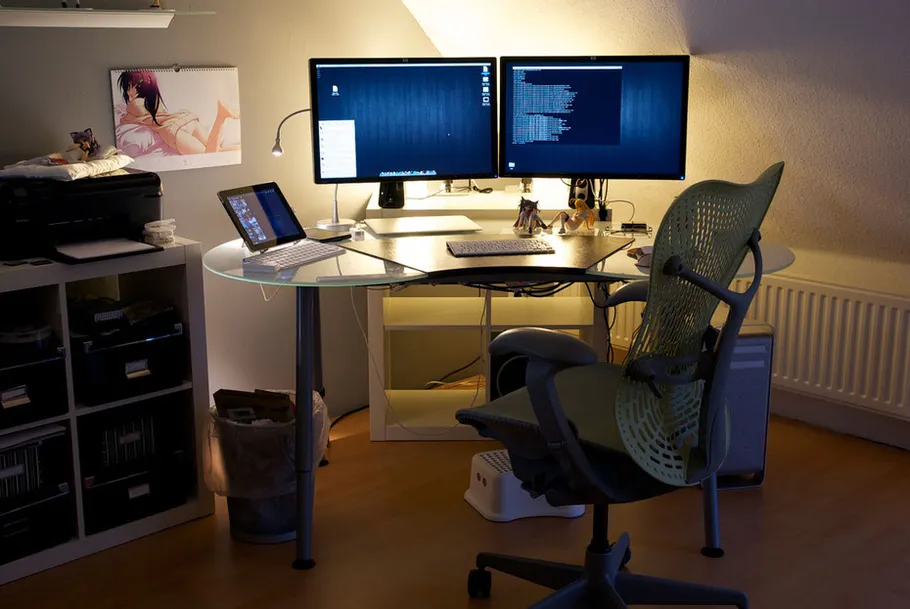
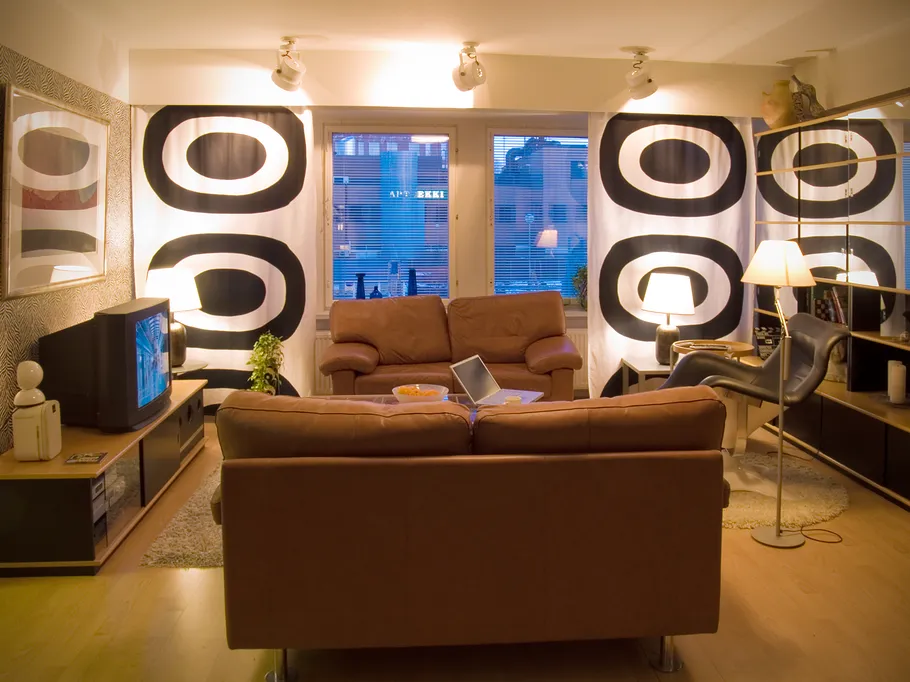
One limit applies to most photos in this guide: only the DeskCycle figures show a real named pick — the original DeskCycle in the featured image and the DeskCycle 2 in its section below, both free-license shots from the maker’s own uploads. No free-license photo of the YOSUDA, MERACH, Sunny, Vaunn or himaly units exists, so those figures are honest generic scenes — desks, living rooms, a clinic and a crankset — captioned as what they actually show, never presented as product shots.
- Pedal height and desk clearance — the peak pedal height, and whether it fits under a standard desk
- Resistance honesty, with disputed and variant-mixed figures flagged rather than averaged
- Footprint and weight as recorded, plus whether the unit stores away or folds
- Display and apps — LCD, detachable display, Bluetooth and the app behind it
- Noise honesty, with maker decibel claims stated as claims, not lab tests
- Honest availability, with conflicting figures stated as conflicts, not resolved by guesswork
Cubii JR1 and JR2 were considered and set aside as elliptical-motion units, not crank-cycle bikes — the pedals travel an oval path rather than a circle, which is a different category. DeskCycle Ellipse was considered and set aside on the same ground, as an elliptical-motion unit from the same maker. Sunny SF-B0418 was considered and set aside as a taller dual-function unit at 15 in high that overlaps the SF-B0891 pick without beating it on any settled figure. Sunny SF-B023005DGY Smart was considered and set aside on thinner corroboration — a stepless unit at 200 lb and 11.7 lb with fewer confirming records. FlexiSpot Sit2Go was considered and set aside as a chair-and-bike combination, a different category from a pedal-only unit. Putnen and GUGTTR electric models were considered and set aside as motorized units — the motor moves the legs for the user, which is a different category from a self-powered bike. Our gym flooring and resistance bands guides cover the floor under the bike and the bands several picks include for arm work.
Comparison
| Bike | Best for | Resistance | Footprint | Standout |
|---|---|---|---|---|
| DeskCycle 2 | Benchmark, lowest pedal height | 8 magnetic levels | Disputed (see section) | Up to 39 lb resistance |
| YOSUDA Under Desk Bike (M-1-01) | Quiet pick with an app | 16 magnetic (disputed: manual 8) | Disputed (see section) | Around 20 dB noise claim |
| MERACH S04 | Highest settled capacity | 16 magnetic levels | 23.6×21.9 in | 280 lb capacity, arm + leg use |
| Sunny Health & Fitness SF-B0891 | Living-room arm + leg pick | 8 magnetic levels | 20.5×16.5 in | 7-in stride, belt drive |
| Vaunn Medical 565E | Gentle, folding rehab pick | Disputed (magnetic claim vs friction knob) | Disputed (see section) | Folds, quick-release frame |
| himaly Mini Exercise Bike (X1368) | Lightest, smallest settled pick | 8 levels (X1368; variants differ) | 15.98×13.8 in | 7.6 lb, mat + strap included |
Read the Footprint column with care, because it mixes two different kinds of figure, not one like-for-like scale. Three picks state a settled footprint — the MERACH at 23.6×21.9 in, the Sunny at 20.5×16.5 in and the himaly at 15.98×13.8 in — while the DeskCycle, YOSUDA and Vaunn rows read Disputed, because their dimension records conflict across listings and manuals, so the table alone does not rank size, and the pick sections carry the full records. Read the Resistance column the same way: the YOSUDA 16 reads disputed against its own manual at 8, and the Vaunn resistance type itself is disputed between a magnetic claim and friction-knob records, so the table alone does not rank resistance either.
Capacity is deliberately NOT a table column, because the capacity records conflict too much to sit in a tidy column — the sections below carry every conflict, and the superlatives here are scoped to settled figures only. On footprint, the smallest settled machine is the himaly at 15.98×13.8 in, and the largest settled is the MERACH at 23.6×21.9 in — the DeskCycle, YOSUDA and Vaunn are excluded because their dimension records conflict. On pedal height, the lowest settled figure is the DeskCycle at 9 in — the Sunny peak reads 10 in, and the Vaunn and himaly knee clearances read 13 in each. On resistance levels, the highest settled count is the MERACH at 16 — the YOSUDA 16 is excluded because its manual reads 8, and the himaly is excluded because its level count varies by variant. On capacity, the highest settled figure is the MERACH at 280 lb, and the lowest settled is a tie at 220 lb between the Sunny and the Vaunn — the DeskCycle is excluded because its capacity reads 270 lb, 350 lb and 500 lb across records, and the himaly is excluded because its capacity reads 100 kg, 150 kg, 220 lb, 242 lb and 330 lb across variants. On unit weight, the heaviest settled machine is the DeskCycle at 23 lb, and the lightest settled is the himaly at 7.6 lb — the Vaunn is excluded because its weight records span 5.4 lb to 16 lb across listings. On folding, the Vaunn is the only folding pick here.
DeskCycle 2
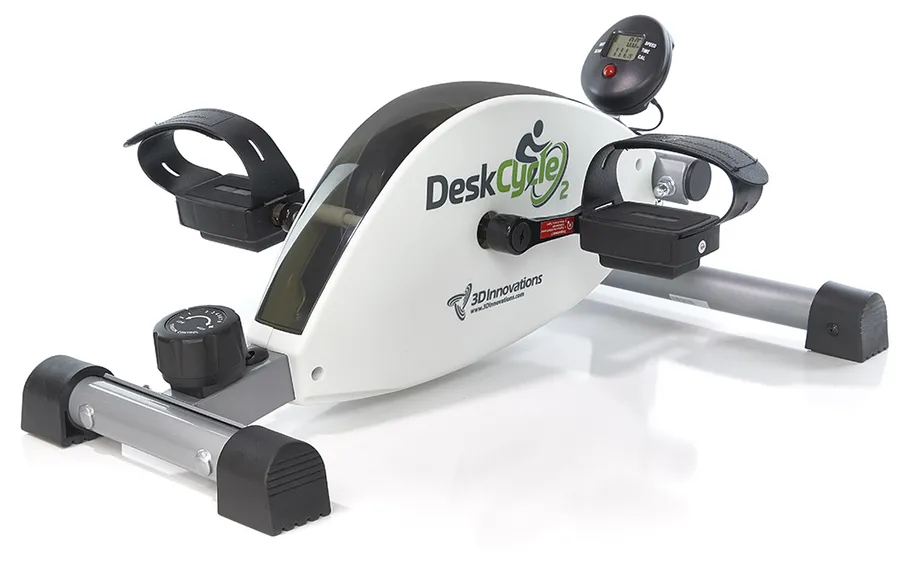
The DeskCycle 2 is the benchmark under-desk bike here, and the pick every other bike gets measured against. The pedals adjust from 9 in to 10 in high, the resistance runs through 8 magnetic levels up to 39 lb, the display detaches from the body for desk-top reading, and the frame is steel on sealed bearings with strap-in pedals — built for all-day pedalling, not occasional use.
The low pedal height is the point. At 9 in on its lowest setting, the DeskCycle 2 fits under desks as low as 27 in, which is where taller units fail — a bike that needs 13 in of knee clearance cannot live under a low desk, while this one can. The magnetic resistance stays smooth across the 8 levels, and the sealed bearings are the reason the unit is repeatedly described as quiet in reviews, even though no lab decibel figure is published for it.
Three flags must be stated plainly. The capacity conflicts across records: review and listing records read 270 lb, 350 lb and 500 lb for what is sold as the same unit — so no settled capacity is claimed, and the pick is excluded from the capacity ranking. The dimensions conflict across three orientation sets: 24.02×10.24×20.08 in on one review record, 24×20×10 in in the manual, and 22.9×11.5×11.1 in on another record — so no settled footprint is claimed either, and the pick is excluded from the size ranking. And the unit weight reads 23 lb on most records against 24.75 lb on one review — a small conflict, but stated here rather than smoothed over.
✅ Pros
- Lowest pedal height here at 9 in — fits desks as low as 27 in
- Up to 39 lb magnetic resistance across 8 levels
- Steel frame, sealed bearings, strap-in pedals, detachable display
⚠️ Cons
- Capacity disputed: 270 lb vs 350 lb vs 500 lb
- Dimensions disputed across three orientation sets
- Weight reads 23 lb against 24.75 lb on one review
Listing check: no confident listing code was found for this machine, so the link above is a tagged search — confirm the pedal height, the 8 magnetic levels and the capacity before ordering.
Best for: low desks and all-day pedalling where pedal height decides everything.
May not fit: buyers who want a settled capacity and footprint figure.
YOSUDA Under Desk Bike (M-1-01)

The YOSUDA Under Desk Bike, model M-1-01, is the quiet pick here: a magnetic pedal unit with Bluetooth and the Fed Fitness app, a claimed noise level around 20 dB, a unit weight of 17.9 lb, and a 260 lb capacity on its listing — plus resistance bands and a mat in the box for arm work between pedalling sessions.
The quiet claim is the point. Around 20 dB is quieter than a whisper on paper, and the magnetic drive is the reason the claim is plausible — no friction pad rubs, so the only sound is the pedal stroke itself. The Bluetooth link and the app add session tracking for buyers who want numbers, and the included bands and mat mean the box covers arm work too, not just pedalling.
Three flags must be stated plainly. The level count conflicts between the listing and the manual: the listing reads 16 magnetic levels, while the manual reads 8 levels for the Classic variant — so the table reads 16 disputed, and the pick is excluded from the levels ranking. The dimensions conflict between the listing at 19.69×17.71×12.99 in and the manual at 21.26×14.37×12.28 in — so no settled footprint is claimed, and the pick is excluded from the size ranking. And one figure must not be misread: a 25 lb figure on some records is a component figure, not the user weight — the user capacity is 260 lb, and the two must not be swapped.
✅ Pros
- Quietest claim here at around 20 dB, magnetic drive
- Bluetooth with the Fed Fitness app for session tracking
- Resistance bands and mat included in the box
⚠️ Cons
- Levels disputed: listing 16 vs manual 8
- Dimensions disputed: listing vs manual sets differ
- The 25 lb figure is a component figure, not user capacity
Listing check: no confident listing code was found for this machine, so the link above is a tagged search — confirm the level count, the dimensions and the 260 lb capacity before ordering.
Best for: quiet rooms and buyers who want app tracking with their pedalling.
May not fit: buyers who want a settled level count and footprint figure.
MERACH S04

The MERACH S04 — sold under the same unit as S04B1 and MR-S04 — is the highest-capacity settled pick here: 16 magnetic levels, Bluetooth with the MERACH app, an LCD display, a belt drive, arm and leg use, resistance bands and a mat in the box, a 23.6×21.9×12.6 in footprint, a 17.8 lb unit weight, and a 280 lb capacity that is consistent across its manuals.
The settled figures are the point. Sixteen levels and 280 lb are the highest settled level count and the highest settled capacity in the guide, and both rest on consistent manual records rather than a single listing — which is rare in this category, where most figures conflict. The belt drive keeps the ride quiet, and the arm-and-leg use means the same unit covers upper-body sessions from a chair, not just leg miles under a desk.
Two flags must be stated plainly. The unit weight reads 17.8 lb on most records against 18 lb on a variant record — a small conflict, but stated here rather than smoothed over. And the footprint at 23.6×21.9 in is the largest settled footprint here, so the MERACH needs the widest desk bay of the settled picks — measure the bay, not just the desk height, before ordering.
✅ Pros
- Highest settled levels at 16 and highest settled capacity at 280 lb
- Bluetooth with the MERACH app plus an LCD display
- Arm and leg use, belt drive, bands and mat included
⚠️ Cons
- Weight reads 17.8 lb against 18 lb on a variant record
- Largest settled footprint — needs the widest desk bay
- Most figures rest on maker records rather than reviews
Listing check: no confident listing code was found for this machine, so the link above is a tagged search — confirm the S04, S04B1 or MR-S04 code, the 16 levels and the 280 lb capacity before ordering.
Best for: heavier users and buyers who want the most settled figures in the guide.
May not fit: narrow desk bays, or buyers who want the smallest unit.
Sunny Health & Fitness SF-B0891
The Sunny Health & Fitness SF-B0891 is the living-room pick here: 8 magnetic levels, a belt drive, a 3.52 lb flywheel, a 19.1 lb unit weight, a 20.5×16.5×10.5 in footprint, a 220 lb capacity, a 7-in stride, an LCD display, arm and leg use, and a 10 in peak pedal height.
The stride and the dual use are the point. A 7-in stride is a longer pedal circle than most mini units, which suits taller users who find short-stride pedals cramped, and the arm-and-leg use means the same unit covers upper-body sessions from the sofa. The belt drive keeps the ride smooth, and the footprint is settled across records, so the room it needs is known before ordering.
Two flags must be stated plainly. The capacity at 220 lb ties the Vaunn for the lowest settled capacity here, so heavier users should look at the MERACH instead. And the 3.52 lb flywheel is light, which means the ride feel is less smooth at the top levels than on heavier-flywheel machines — the 8 magnetic levels still give a range, but the top end is modest.
✅ Pros
- 7-in stride — longer pedal circle for taller users
- Arm and leg use with a belt drive and LCD display
- Settled footprint at 20.5×16.5 in across records
⚠️ Cons
- Lowest settled capacity tie at 220 lb
- Light 3.52 lb flywheel — modest top-end feel
- 10 in peak pedal height needs a clearance check
Listing check: no confident listing code was found for this machine, so the link above is a tagged search — confirm the SF-B0891 code, the 7-in stride and the 220 lb capacity before ordering.
Best for: living-room pedalling with arms or legs while watching TV.
May not fit: heavier users, or low desks under 27 in without a clearance check.
Vaunn Medical 565E
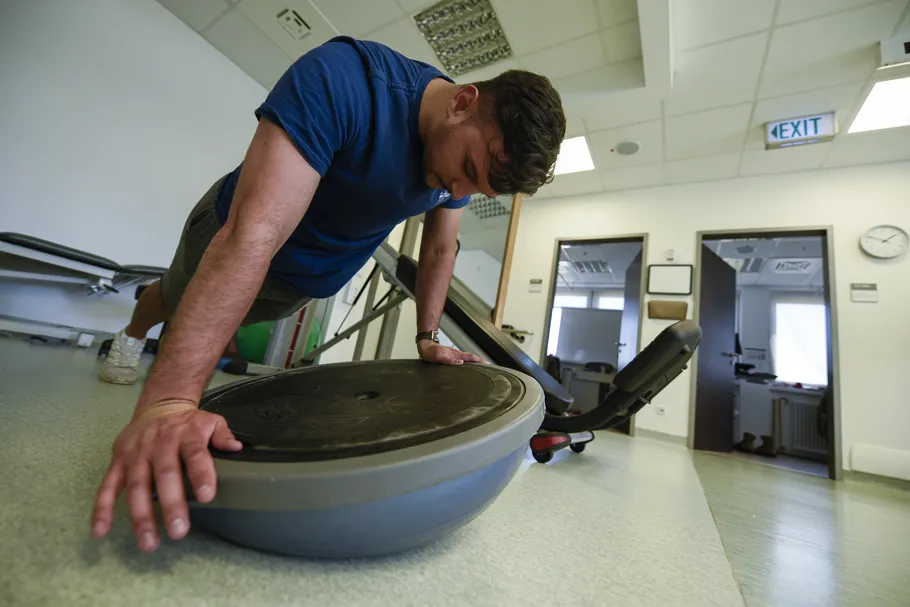
The Vaunn Medical 565E — sold in the 565-SERIES-E line — is the gentle, folding pick here: a quick-release folding frame, an LCD display, arm and leg use, a 220 lb capacity, and a 13 in knee-to-table clearance. The maker positions it for gentle, rehab-style use, and states plainly that it is NOT designed for rigorous use — a limit this guide keeps, not softens.
The folding frame is the point. The quick-release frame folds for storage where every other pick here claims its floor space permanently, which suits small flats and rooms that must serve two purposes. The gentle positioning suits users rebuilding movement or keeping joints moving at low load, and the 13 in knee clearance is stated so desk fit can be checked before ordering.
Four flags must be stated plainly. The dimensions conflict four ways: 19×15.5×11.25 in on one listing, 20.9×10.6×14.5 in on another, 20×16×13 in on a third, and 18.75×15.5×11.25 in on a fourth — so no settled footprint is claimed, and the pick is excluded from the size ranking. The unit weight conflicts just as widely, at 5.7 lb, 5.4 lb, 12.2 lb and 16 lb across listings — so no settled weight is claimed either. The level count reads 5 on the 565E records against 16 on the 565EP-2 variant — so the variant must be confirmed on the listing. And the resistance type itself is disputed, between a magnetic claim on some records and friction-knob records on others — so the table reads the resistance as disputed.
✅ Pros
- Only folding pick here — quick-release frame stores away
- Gentle, rehab-style positioning with arm and leg use
- LCD display and a stated 13 in knee clearance
⚠️ Cons
- Dimensions conflict four ways; weight spans 5.4 lb to 16 lb
- Resistance type disputed: magnetic claim vs friction knob
- NOT designed for rigorous use — gentle sessions only
Listing check: no confident listing code was found for this machine, so the link above is a tagged search — confirm the 565E code against the 565EP-2 variant, the folding frame and the 220 lb capacity before ordering.
Best for: gentle, rehab-style sessions and rooms where the bike must fold away.
May not fit: hard training, or buyers who want settled dimensions and weight.
himaly Mini Exercise Bike (X1368)
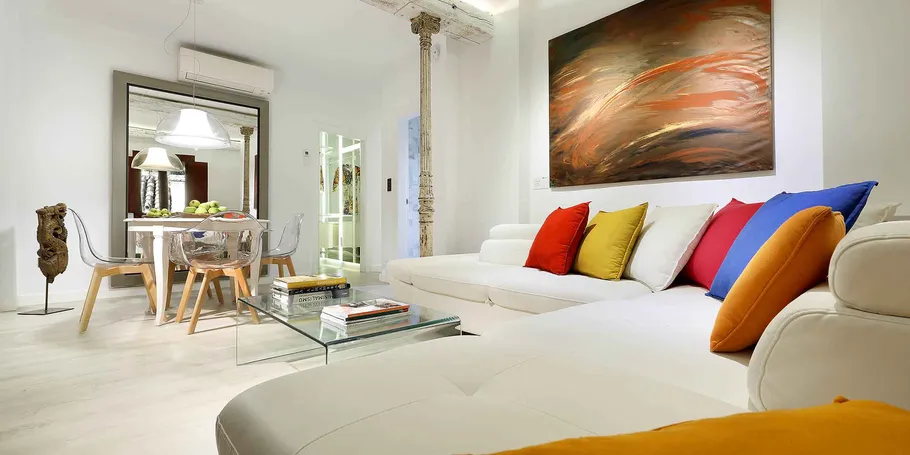
The himaly Mini Exercise Bike, model X1368 as the main record, is the smallest and lightest settled pick here: 8 levels on the X1368 manual, a 7.6 lb unit weight, a 15.98×13.8×12.6 in footprint, an LCD display, arm and leg use, a mat and a strap in the box, and a 13 in knee clearance.
The size and weight are the point. At 7.6 lb and under 16 in long, the himaly lifts with one hand and slides under a desk, into a cupboard or behind a sofa — the most portable unit here by a wide margin. The mat and strap in the box cover floor protection and foot hold without extra purchases, and the arm-and-leg use means the same unit covers upper-body sessions from a chair.
Three flags must be stated plainly. The capacity conflicts across variants: 150 kg on the X1368 record, 100 kg on another, 220 lb and 242 lb on the X1367 records, and 330 lb on the X1369 — so no settled capacity is claimed, and the pick is excluded from the capacity ranking. The level count varies by variant: 8 on the X1368 manual, 6 on the X1369, and an adjustable knob on the X1367 — so the model code must be confirmed on the listing. And the unit weight varies by variant too, at 7.6 lb on the X1368, 5.89 lb on the X1367 and 8.7 lb on another record — so the table uses the X1368 figure with the variant flag.
✅ Pros
- Lightest settled at 7.6 lb and smallest settled footprint here
- One-hand portable — slides under a desk or into a cupboard
- Mat and strap included, arm and leg use, LCD display
⚠️ Cons
- Capacity conflicts across variants: 100 kg to 330 lb
- Levels vary by variant: 8 vs 6 vs adjustable knob
- Model code must be confirmed — X1368 vs X1367 vs X1369
Listing check: no confident listing code was found for this machine, so the link above is a tagged search — confirm the X1368 code against the X1367 and X1369 variants, the 7.6 lb weight and the capacity before ordering.
Best for: small flats and buyers who want the lightest, most portable unit.
May not fit: buyers who want a settled capacity figure or a single level count.
How to Choose
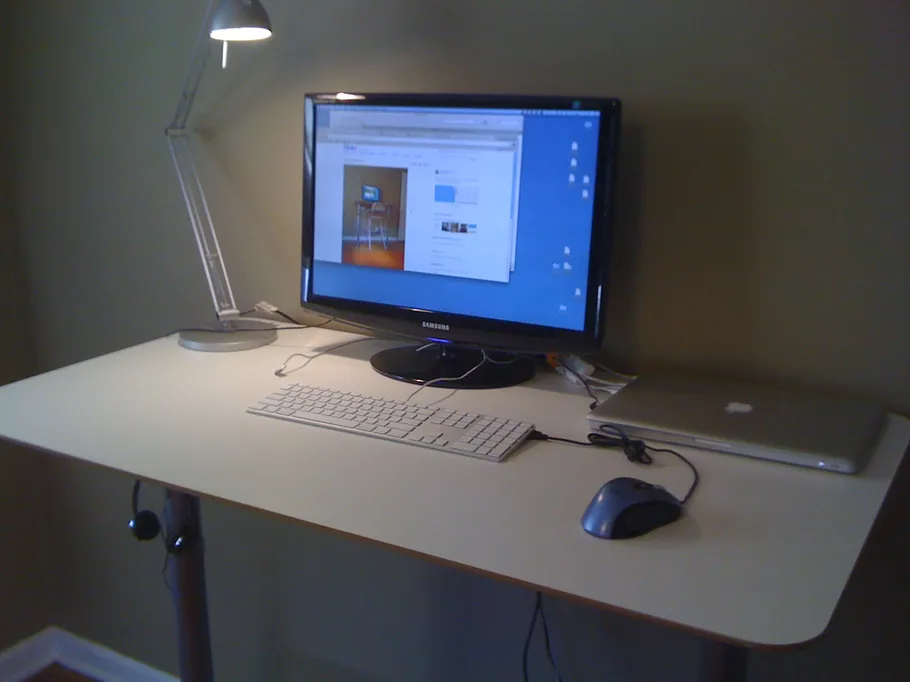
Choosing an under-desk bike starts with the desk, not the bike. Measure the clearance under the desk apron, check the chair, and only then compare resistance, displays and noise — a bike that does not fit the desk is a bad buy at any level count.
Pedal Height and Desk Clearance
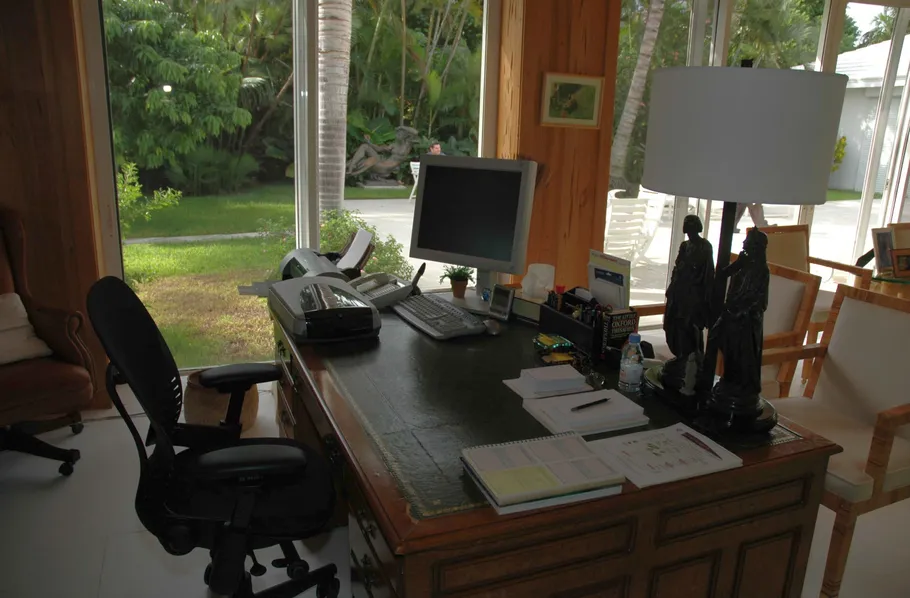
Pedal height is the distance from the floor to the top of the pedal stroke, and it decides whether the knees clear the desk. The DeskCycle 2 at 9 in is the lowest settled figure here, the Sunny peaks at 10 in, and the Vaunn and himaly state a 13 in knee clearance each — so a desk under 27 in suits the DeskCycle first, while a 13 in clearance needs a higher desk or a lower chair.
Measure twice: once from the floor to the underside of the desk apron, and once with shoes on, because shoe height adds to the pedal arc. A chair without wheels holds still better than a rolling chair, which creeps away from the pedals, and a desk with a modesty panel or a crossbar under the top can block the pedal arc even when the height looks right.
Resistance: Magnetic or Knob
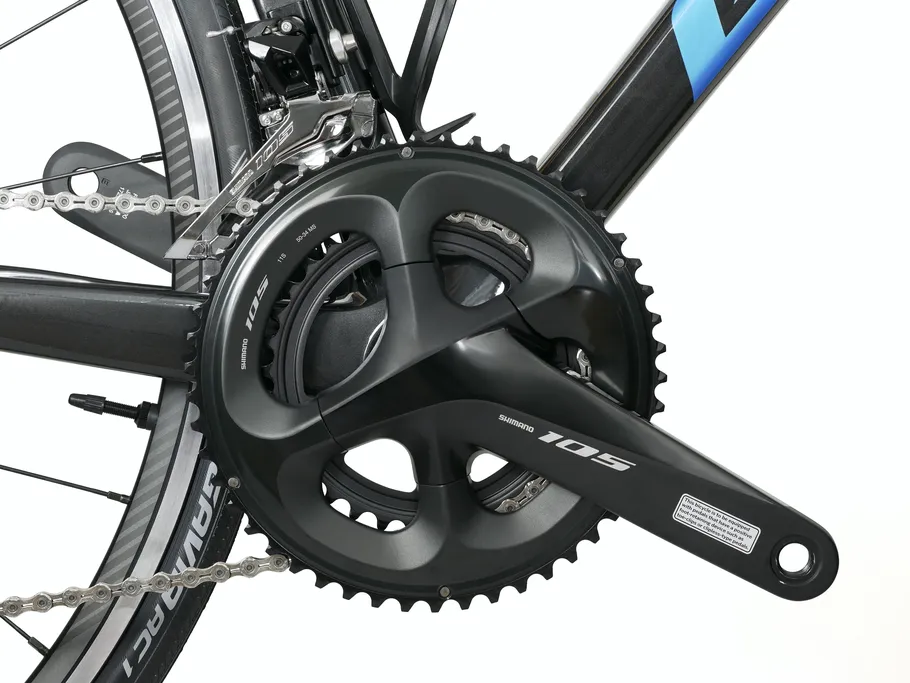
Magnetic resistance uses magnets around a flywheel, so nothing touches and nothing wears — the ride stays smooth and quiet across the levels. A friction knob presses a pad against the wheel, which is simpler and cheaper but wears, squeaks and needs replacing over time.
Four picks here state magnetic resistance — the DeskCycle 2 at 8 levels, the MERACH at 16, the Sunny at 8 and the YOSUDA at a disputed 16 against its manual at 8 — while the Vaunn resistance type itself is disputed between a magnetic claim and friction-knob records. More levels mean finer steps, not more total resistance: the DeskCycle 2 at 8 levels reaches up to 39 lb, while a 16-level bike can still top out lower, so compare the top resistance, not just the count.
Display and Apps

Every pick here carries an LCD display for speed, time, distance and calories, but the displays differ in where they sit. The DeskCycle 2 display detaches from the body for desk-top reading, while the other picks fix the display to the body, which means looking down at the floor to read it mid-session.
Two picks add Bluetooth and an app: the YOSUDA with the Fed Fitness app and the MERACH with the MERACH app. An app adds session history and goals, but it also adds a phone dependency — check that the app still runs on the buyer’s phone and that its reviews mention the bike by name, because a generic fitness app with no bike link is just a timer with a logo.
Noise, Floor and Storage
Noise decides whether the bike survives a shared room. Magnetic drives run quieter than friction knobs, and the YOSUDA around-20 dB claim is the quietest figure here — but it is a maker claim, not a lab test, so treat it as a direction, not a measurement. A mat under the bike cuts floor noise and protects the floor, and several picks include one in the box.
Storage decides whether the bike survives a small flat. The Vaunn folds on a quick-release frame, the himaly at 7.6 lb lifts with one hand into a cupboard, and the heavier picks at 17 lb to 23 lb stay where they are put. Check the folded or stored size against the cupboard, not just the riding footprint against the desk.
Safety
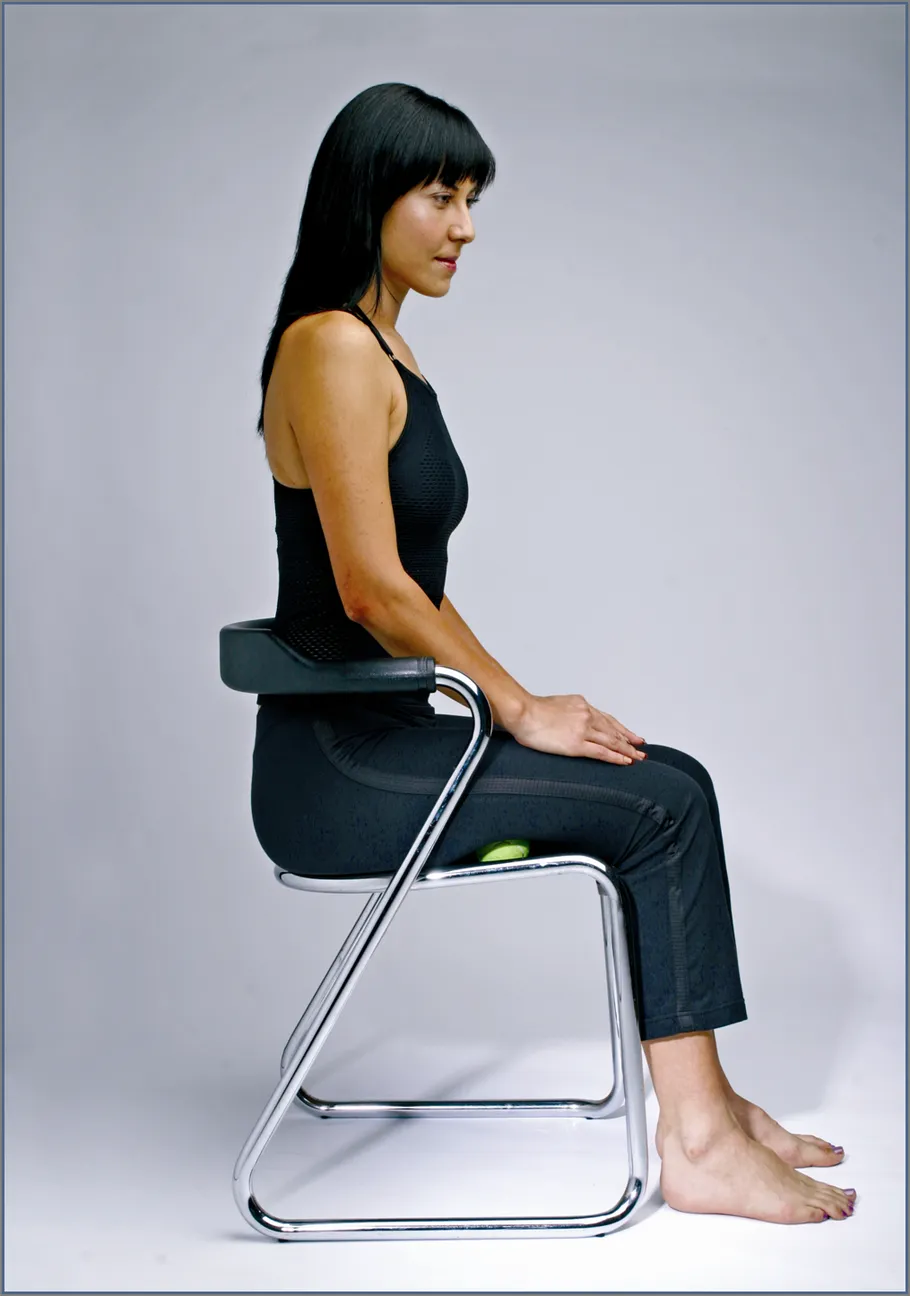
Under-desk bikes look gentle and still load the knees rep by rep, so treat the first sessions with care. A little knee support helps here too — our knee sleeves guide covers sleeves for warmth and compression during seated pedalling, which add comfort without changing the movement.
1. Measure the desk clearance and the pedal height before the first ride — knees hitting the desk apron mid-stroke strain the knees and the desk alike.
2. Start at the lowest resistance for short sessions — ten easy minutes beats an hour at a level the knees were not ready for.
3. Use a stable chair without wheels, or lock the castors — a rolling chair creeps away from the pedals and the posture collapses with it.
4. Keep the feet strapped or flat on the pedals — a slipping foot twists the ankle, especially on strap-in pedals at higher levels.
5. Stop for sharp knee pain, swelling, numbness or clicking that was not there before — easy miles should feel easy, and pain is the signal to stop, not to push through.
6. Keep children and pets clear of moving pedals — a pedal unit looks like a toy until the cranks turn, and small hands reach for moving parts.
7. Check the bike, the mat and the walkway after training, so the unit, its straps and its cord do not trip anyone in the dark.
Under-desk bike training is general fitness information, not medical advice. Stop and seek professional advice if you feel sharp knee, hip or ankle pain, swelling, numbness, dizziness or shortness of breath, or if you have a knee, hip, back or heart condition, or are recovering from surgery or injury.
Frequently Asked Questions

What is an under-desk bike?
A crank-cycle pedal unit that sits on the floor under a desk: two pedals, a small body and a resistance control, with no seat and no handlebar — the office chair is the seat, and the legs turn the pedals while the hands stay on the keyboard.
Will an under-desk bike fit under my desk?
It depends on the pedal height, and the figures must be checked. The lowest settled pedal height here is the DeskCycle 2 at 9 in, which fits desks as low as 27 in, the Sunny peaks at 10 in, and the Vaunn and himaly state a 13 in knee clearance each — so measure from the floor to the underside of the desk apron, with shoes on, before ordering.
Is magnetic resistance worth it?
Yes, for quiet and for wear. Magnetic resistance uses magnets around a flywheel with nothing touching, so the ride stays smooth and quiet, while a friction knob presses a pad that wears and can squeak — and the Vaunn resistance type itself is disputed between a magnetic claim and friction-knob records, so confirm it on the listing.
Can I use an under-desk bike for my arms too?
Yes, on the picks built for it. The MERACH, the Sunny, the Vaunn and the himaly all support arm use from a chair, and the YOSUDA and MERACH include resistance bands in the box — but the DeskCycle 2 is a legs-only unit, so arm work needs a different pick.
How quiet are under-desk bikes really?
Quieter than a full-size bike, but noisier than silence. The YOSUDA around-20 dB claim is the quietest figure here, yet it is a maker claim, not a lab test — magnetic drives run quieter than friction knobs, a mat under the bike cuts floor noise, and a shared room still hears the pedal stroke.
What pairs well with an under-desk bike?
Floor protection for the room, knee comfort for long sessions, and recovery for the legs after — our foam rollers guide covers rollers for leg recovery once easy miles become a daily habit.
Our Pick: Start Here
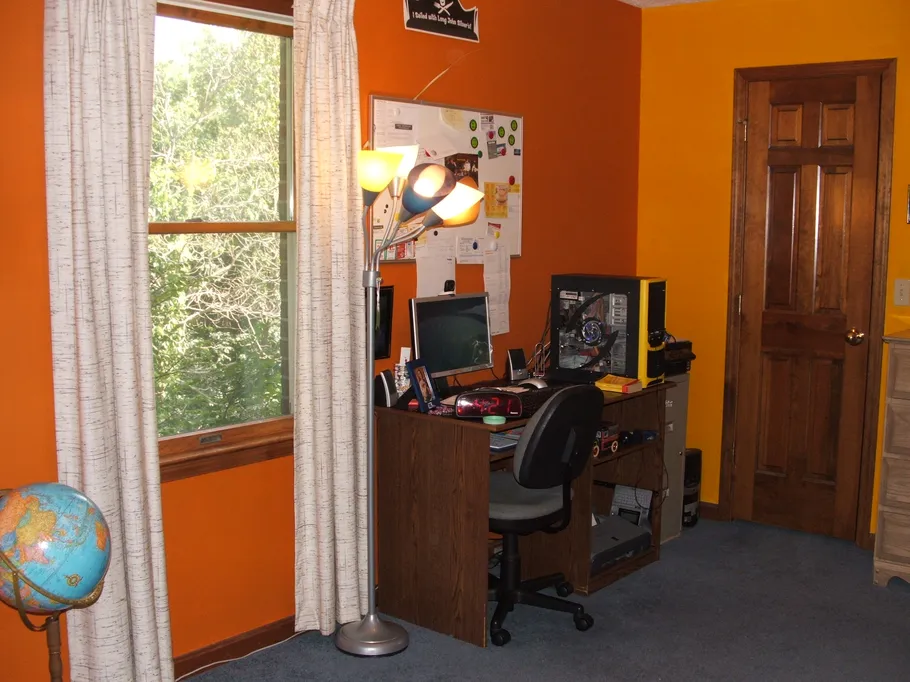
Start with the DeskCycle 2 if the desk is low, the YOSUDA Under Desk Bike if quiet matters most, the MERACH S04 if the highest settled capacity and level count matter most, the Sunny Health & Fitness SF-B0891 if living-room pedalling with arms or legs matters most, the Vaunn Medical 565E if gentle sessions and folding storage matter most, and the himaly Mini Exercise Bike if the smallest, lightest unit matters most — then measure the desk, confirm the model code on the listing, and start at the lowest resistance.
As an Amazon Associate, this site earns from qualifying purchases made through links in this guide, at no extra cost to you. The Amazon links above are tagged search links, not direct product listings, because no confident listing code was verified for these machines — always confirm the exact model, specifications and capacity on the listing before ordering.
Specifications in this guide come from maker manuals, listings and review records that frequently disagree, and every disagreement found is stated in the pick sections rather than averaged away. Figures may change between listings and variants, so treat this guide as a comparison of published records, not as a substitute for the listing on the day of purchase.