

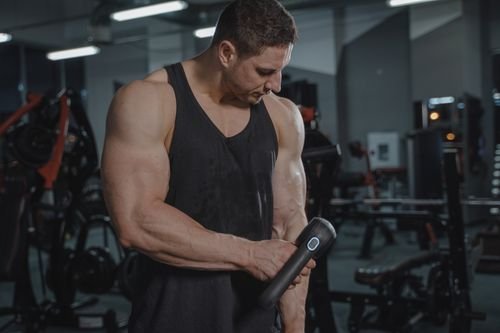
🏋️ You finished a hard session. Your legs feel heavy, your shoulders are tight, and someone at the gym is already buzzing away with a massage gun.
It looks satisfying. But does it actually help — and which one is worth your money?
This guide answers both questions honestly. Six real, currently sold massage guns, compared on specs and verified buyer-review volume — with the evidence stated plainly, including where it falls short.
🔍 What the Evidence Actually Says
Massage guns are popular, but the science is still young — and this guide will not oversell it.
A 2023 systematic review of 13 studies (255 participants) found improvements in acute strength, explosive strength, and flexibility, plus less pain after multiple treatments — but every study in it had methodological limitations.
A 2021 review of 39 studies found flexibility up and delayed-onset soreness down, but no significant effect on force or muscle activation.
A 2023 review of 11 studies agreed on the flexibility benefit, while strength, balance, and agility results were inconsistent.
A more recent review of randomised trials (through November 2025) found a possible improvement in explosive-performance recovery and lower early creatine kinase levels — but no clear benefit for maximum-strength recovery or soreness relief.
Put together, the honest summary is this: perceived soreness and short-term flexibility are the best-supported benefits.
Faster muscle recovery, healing injuries, and replacing professional treatment are NOT proven. Anyone promising those three things is selling, not informing.
📋 How We Chose These Picks
This is a research-based guide. We did not buy or test these products, and no product here is described as personally tested.
Picks were scored on five things: amplitude and stall force (how deep the massage reaches), speed range, battery life, noise and weight, and verified buyer-review volume.
Prices change constantly, so this guide does not quote them. Use the check-price links to see the current price before you buy.
Every product below is currently sold on Amazon with a verified listing. If a listing could not be verified, the product did not make the list.
⚡ Quick Comparison
| Product | Amplitude | Speed range | Standout feature | Best for |
|---|---|---|---|---|
| Theragun Prime (5th Gen) | 16 mm | 1,750–2,400 PPM | Bluetooth app, 120-min battery | Best overall |
| Hypervolt 2 Pro | — | 1,700–2,700 RPM | QuietGlide motor, 5 heads | Best quiet premium |
| Theragun Pro (5th Gen) | 16 mm | — | 60 lb stall force, force meter | Best deep tissue |
| Bob and Brad D6 Pro | 16 mm | 1,500–2,500 RPM | Physio-designed, value tier | Best value deep tissue |
| TOLOCO EM26 | 12 mm | Up to 3,200 RPM | 10 heads, huge review volume | Best budget |
| Bob and Brad Q2 Mini | — | 5 speeds | Pocket-sized, ~435 g, carry case | Best travel |
One pattern jumps out immediately: the serious deep-tissue guns all use a 16 mm amplitude, while the budget pick trades depth for price at 12 mm.
1. 🏆 Theragun Prime (5th Gen) — Best Overall
Who it suits: regular lifters who want one gun that does everything well, and like app-guided routines.
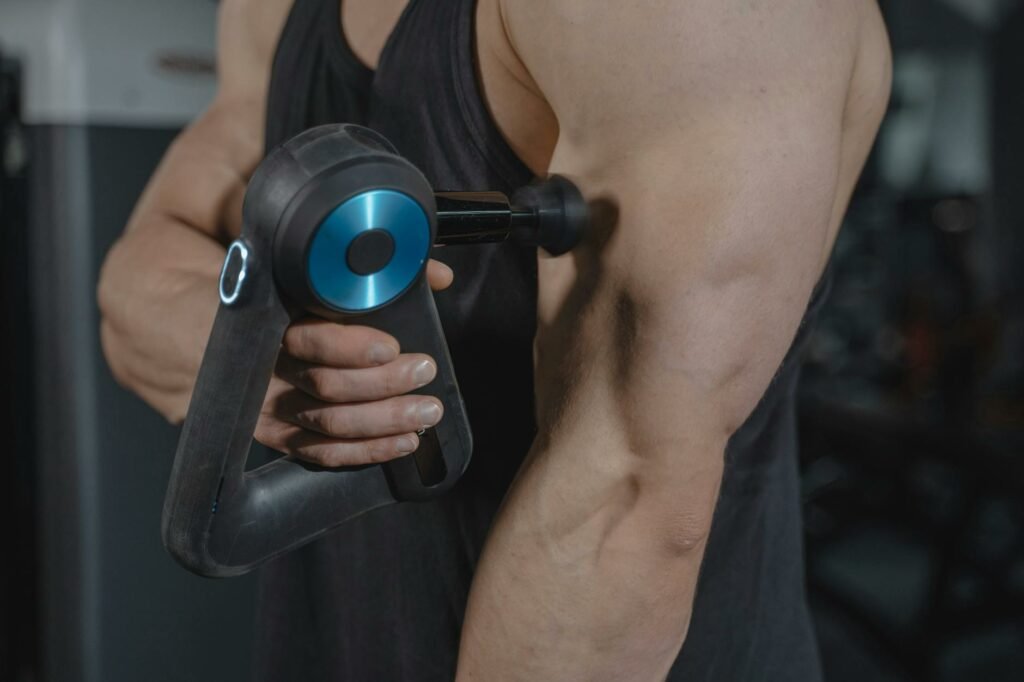
The Prime pairs a 16 mm amplitude with a 1,750–2,400 PPM speed range, so it covers both gentle warm-ups and deeper post-session work.
Its 120-minute battery is among the longest here, and the Bluetooth app adds guided routines if you want structure.
Pros: deep 16 mm reach; long battery life; app routines included; four attachments in the box.
Cons: premium price tier; heavier than a mini gun; the app is a bonus, not a necessity.
Check the current price of the Theragun Prime (5th Gen) on Amazon
2. 🔇 Hypervolt 2 Pro — Best Quiet Premium
Who it suits: people who train at home, share walls with neighbours, or just hate loud gadgets.
Hyperice’s QuietGlide motor keeps this gun noticeably quieter than most pro-level rivals, while still offering five speeds and five heads.
At around 2.6 lb it is also lighter than many full-power guns, and the 1,700–2,700 RPM range covers gentle to intense work.
Pros: quiet for its power class; light for a pro gun; five speeds and five heads; trusted premium brand.
Cons: premium price tier; no deep-tissue amplitude figure published as prominently as Theragun’s 16 mm.
Check the current price of the Hypervolt 2 Pro on Amazon
3. 💪 Theragun Pro (5th Gen) — Best Deep Tissue
Who it suits: big lifters and athletes with dense muscle who find ordinary guns stall out.
The Pro’s headline number is its 60 lb stall force — the pressure it can take before the motor stalls — the highest in this guide.
Its OLED force meter shows how hard you are pressing, and the adjustable arm helps you reach your own back.
Pros: strongest stall force here; force meter removes guesswork; adjustable arm for hard-to-reach spots; app included.
Cons: the heaviest and priciest pick here; overkill if you train lightly or just want a gentle massage.
Check the current price of the Theragun Pro (5th Gen) on Amazon
4. 🩺 Bob and Brad D6 Pro — Best Value Deep Tissue
Who it suits: lifters who want true 16 mm deep-tissue reach without paying a premium-brand price.
The D6 Pro was designed with physiotherapists, and it shows in the spec sheet: 16 mm amplitude with six speeds from 1,500 to 2,500 RPM.
That is pro-level depth at a value-tier price — the strongest value proposition in this guide.
Pros: genuine 16 mm amplitude; six speeds; physio input behind the design; far cheaper than premium rivals.
Cons: the D6 family has many similarly named variants (Max+, Ultra, Plus) — buy the classic D6 Pro only; the brand is less established than Therabody or Hyperice.
Check the current price of the Bob and Brad D6 Pro on Amazon
5. 💰 TOLOCO EM26 — Best Budget
Who it suits: first-time buyers who want to try percussive massage without spending much.
The EM26 is one of the best-reviewed massage guns on Amazon, with over 62,000 ratings, and the brand claims a bestseller spot in its category.
You get 10 attachments and speeds up to 3,200 RPM, which is plenty for general post-workout use.
Pros: the cheapest route in; 10 heads included; huge verified review volume; simple to use.
Cons: 12 mm amplitude means less deep reach than the 16 mm guns; budget build quality; noise reports vary.
Check the current price of the TOLOCO EM26 on Amazon
6. ✈️ Bob and Brad Q2 Mini — Best Travel
Who it suits: anyone who wants a massage gun in a gym bag, backpack, or suitcase.
The Q2 Mini is genuinely pocket-sized at around 435 g, with five speeds and a carry case in the box.
It is the gun you will actually take with you — which matters more than raw power you leave at home.
Pros: truly pocketable and light; carry case included; five speeds; same physio-linked brand as the D6 Pro.
Cons: a mini motor cannot match a full-size gun for deep tissue; smaller battery; check the colour variant when ordering (the Ocean Blue variant is linked here).
Check the current price of the Bob and Brad Q2 Mini on Amazon
🧭 How to Choose the Right Massage Gun
Stall force is how much pressure the motor tolerates before it stalls. Higher stall force (like the Pro’s 60 lb) means the gun keeps pounding on dense muscle instead of bogging down.
Amplitude is how far the head travels in and out. A 16 mm stroke reaches deeper tissue than a 12 mm stroke — the main reason premium guns feel stronger.
Speed levels (measured in PPM or RPM) set intensity. More levels give finer control, but the top speed matters less than you think — most people live in the middle range.
Battery life figures are best-case claims, usually at low speed. A 120-minute claim may mean far less at full power, so treat it as a rough guide.
Noise is measured in decibels by brands, but testing conditions differ — one brand’s “quiet” may not match another’s. Independent reviews are more useful than spec sheets here.
Weight matters more than it sounds. A 2.6 lb gun feels fine for a minute and heavy after five, especially when reaching your own back.
Attachments cover different jobs: a round ball for large muscle groups, a flat head for general use, a bullet or cone for small spots, and a fork shape for either side of the spine or Achilles.
One honest caveat covers all of the above: brands measure these numbers differently, so compare them as rough guides, not laboratory facts.

⚠️ Safety: Where Not to Use One, and Who Should Ask First
Massage guns are safe for most healthy adults on fleshy muscle — but there are clear no-go zones.
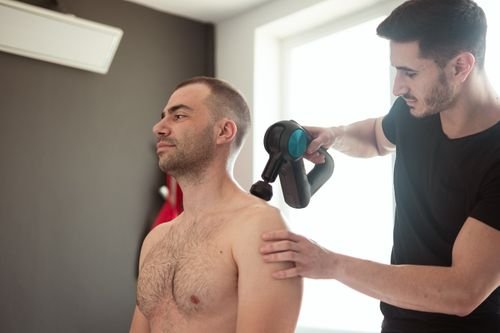
Never use one on the front or sides of the neck, directly over the spine, or on bony areas like knees, elbows, ankles, ribs, and collarbones.
Never use one on injured or inflamed areas, bruises, open wounds, or anywhere you suspect a fracture.
Never use one on or around the eyes — a published case report describes a lens dislocation after a man used a massage gun around his eye for two months.
Talk to a clinician first if you have a clotting disorder, take blood thinners, are pregnant, have an implanted device, have neuropathy or numbness, or have osteoporosis.
As general guidance, keep sessions short — one source suggests a maximum of about 15 minutes total, with around 2 minutes per muscle area. That is guidance, not a rule.
If pain persists, gets worse, or you are unsure about your condition, stop and see a professional. This section is general information only, not medical advice.
❓ Frequently Asked Questions
Do massage guns actually speed up muscle recovery?
The evidence is mixed. Reviews support short-term flexibility gains and help with perceived soreness, but faster recovery itself is not clearly proven.
Think of a massage gun as a comfort and mobility tool, not a recovery shortcut.
How long should I use one on each muscle?
General guidance suggests around 2 minutes per muscle area, within a session of roughly 15 minutes total.
Start on a low speed, keep the gun moving slowly, and stop if anything hurts sharply.
Can I use a massage gun every day?
Many people do, on healthy muscle, with short sessions. Avoid sore, bruised, or injured spots, and give any tender area a rest day.
Daily use is no substitute for rest, sleep, and proper training load.
Are massage guns safe for everyone?
No. People with clotting disorders, those on blood thinners, pregnant women, people with implanted devices, neuropathy, or osteoporosis should talk to a clinician first.
Everyone should avoid the neck front and sides, the spine itself, bony areas, and injured tissue.
What is stall force, and does it matter?
Stall force is the pressure at which the motor stalls. It matters most for dense muscle like glutes and thighs, where weaker guns bog down.
For lighter use on arms and calves, even a budget gun’s stall force is usually enough.
Is a budget massage gun good enough?
For general post-workout use, yes — the TOLOCO EM26’s review volume shows thousands of happy buyers at the budget tier.
You give up depth (12 mm vs 16 mm amplitude) and some build quality, but for a first gun that is a fair trade.
🔗 Keep Reading
For the wider recovery picture, see our guide to massage for healing and our stretching exercises guide — both pair naturally with a massage gun routine.
And if you are building the home gym around your recovery work, our best dumbbells for home guide covers the training side.
As an Amazon Associate, we earn from qualifying purchases made through links on this page, at no extra cost to you.
This is a research-based guide: products were compared from verified buyer reviews and published specifications, not from personal testing. Prices change frequently, so always check the current price before buying. The health and safety information here is general information only and is not medical advice — talk to a qualified clinician about your own situation.