

Iron plates clang, crack concrete, and punish a dropped bar. Bumper plates exist to fix that. 🏋️
A bumper plate is a thick rubber plate with a steel centre hub, made to be dropped from overhead or shoulder height without damaging the bar, the floor, or itself.
But let us be plain from the start: bumper plates are built to be dropped, but they do not make dropping a bar safe on any floor, they do not replace a proper platform or mats, and they do not fix poor lifting technique.
Drop on a platform or rubber mats, with collars locked and enough weight on the bar. A bare concrete floor, a thin rug, or a bar loaded with only small plates is not a dropping setup — it is a damage setup.
Used the right way, bumpers are the single most useful upgrade for a home gym that does Olympic lifts, deadlifts, or high-rep barbell work.
How We Picked These Plates
This guide is research-based. We did not buy or hands-on test these plates, and we do not claim otherwise.
We compared verified buyer reviews and manufacturer specifications, and we checked each product’s Amazon listing status through search results and listing trackers.
We picked 6 plates that are genuinely sold and cover different needs: an all-round training plate, a budget economy line, a complete starter set, a colour-coded set, a thin-profile low-bounce plate, and a value set.
Prices are not quoted in this guide because they change often — and bumper plates are heavy, so shipping and set size move the total a lot. The check-price links take you to the current listing, where you can see the latest price and availability.
Availability and set contents vary a lot: some listings sell singles, some pairs, some full sets. Always confirm exactly what the listing includes — one plate, a pair, or a set — before ordering.
Quick Comparison
| Plate | Build | Diameter | Best for |
|---|---|---|---|
| REP Fitness Black Bumper Plates | Virgin rubber, steel insert | Full diameter | Best overall |
| Titan Fitness Economy Series | Rubber, steel core | 450 mm | Best budget |
| CAP Barbell Economy 260 lb Set | Rubber, steel floating hub | Uniform diameter | Best complete set |
| HulkFit Color Coded | High-density rubber, stainless insert | 17.75 in | Best colour-coded |
| Synergee Bumper Plates | Rubber polymer | 17.5 in | Best thin profile |
| BalanceFrom Color Coded | High-density rubber, steel hub | Standard Olympic | Best value set |

Photo: stu_spivack / Wikimedia Commons
1. REP Fitness Black Bumper Plates — Best Overall
Who it suits: lifters who want one dependable training plate for Olympic lifts, CrossFit-style work, and heavy barbell training.
REP’s Black Bumper Plates are made from virgin rubber with a steel insert, in black with white raised lettering, sold as pairs and sets from 10 to 45 pounds. The 10-pound plates are extra thick — about an inch — which matters, because thin 10s are the plates most likely to bend or crack when dropped.
REP describes the plates as low bounce, and says they are factory-tested to survive more than 12,000 drops from eight feet. That is the maker’s test figure, not an independent result, but it is a serious durability claim backed by a long sales record.
One independent review roundup puts the weight tolerance at about ±1%, which is tight for a training plate — close to competition accuracy without the competition price.
Pros: virgin rubber with a steel insert; extra-thick 10-pound plates; low bounce; pairs and sets available; strong review record.
Cons: no confident US product-page link was found, so this is a search link — check the listing before ordering; black only, so you read markings rather than colours; premium training plates cost more per pound than economy lines.
👉 Search for REP Fitness Black Bumper Plates on Amazon
2. Titan Fitness Economy Series — Best Budget
Who it suits: home gym lifters who want drop-safe plates at the lowest sensible price, and do not need competition accuracy.
Titan’s Economy Series plates use a rubber exterior with a steel core, at the 450 mm IWF-standard diameter, so even the lightest plates hold the bar at the correct pulling height for Olympic lifts. They are sold in weights from 10 to 45 pounds, as pairs and in 230-pound and 260-pound sets.
The trade-off is tolerance: Titan lists ±3%, which is wider than premium plates. A 45-pound plate could legitimately weigh anywhere from about 43.6 to 46.4 pounds. That is fine for general training, but it is not competition-grade precision.
One independent testing roundup named the Economy Series its best budget bumper plate, and praised the steel-core bond and the low bounce for the price.
Pros: lowest sensible price per pound; 450 mm standard diameter; steel core; low bounce; pairs and full sets available.
Cons: no confident US product-page link was found, so this is a search link — check the listing before ordering; ±3% tolerance is wide; all black, so no colour coding; some listings sell singles and some pairs — confirm before ordering.
👉 Search for Titan Fitness Economy Series bumper plates on Amazon
3. CAP Barbell Economy 260 lb Set — Best Complete Set
Who it suits: lifters building a home gym from scratch who want one box that covers the full weight range.
CAP’s 260-pound Economy set includes pairs of 10, 15, 25, 35, and 45-pound plates, all with a 2-inch centre hole for Olympic bars and a steel floating hub. The rubber is a medium-bounce blend, and the plates carry colour-coded markings for quick identification.
That range matters: with pairs from 10 to 45, you can load anything from a 65-pound warm-up bar to a 305-pound bar with the bar itself — without buying a second set six months later.
The set ships in multiple boxes, which may arrive on different days, so keep the packaging until you have checked every pair.
Pros: complete 10-to-45 range in one set; steel floating hubs; medium-bounce rubber; colour-coded markings; long-established budget brand.
Cons: the Amazon product link below rests on a single source, so confirm the listing before ordering; medium bounce is livelier than the low-bounce picks above; 30-day manufacturer warranty is short next to premium plates; set ships in multiple boxes.
👉 Check price on Amazon (please confirm the listing matches the CAP 260 lb Economy set — its link is single-source, see the note in our research).
4. HulkFit Color Coded Bumper Plates — Best Colour-Coded
Who it suits: lifters who want to read the bar at a glance, and anyone training with others who share the plates.
HulkFit’s plates use high-density rubber with a solid stainless steel insert, in bright colours by weight, with both pound and kilogram markings. They come in weights from 10 to 55 pounds, at a 17.75-inch diameter with a 2-inch centre hole.
Colour coding is a real training convenience: you see the load without reading small numbers between sets. But note that pound colour coding is not universal — one brand’s red 45 is another brand’s red 55 — so learn your own set’s chart, and do not assume colours match across brands.
HulkFit warns that its 10-pound and 15-pound plates are not designed to be used alone on the bar — they can bend that way. That warning applies to most thin light bumpers, and it is worth heeding on every brand here.
Pros: bright colour coding by weight; dual pound and kilogram markings; stainless steel insert; low-bounce design; weights up to 55 pounds.
Cons: the Amazon product link below rests on a single source, so confirm the listing before ordering; plates are sold singly, so order two of each weight for barbell use; one recent listing crawl showed no featured offers, so check availability.
👉 Check price on Amazon (please confirm the listing matches the HulkFit colour-coded plate — its link is single-source, and plates are sold singly, so order pairs).
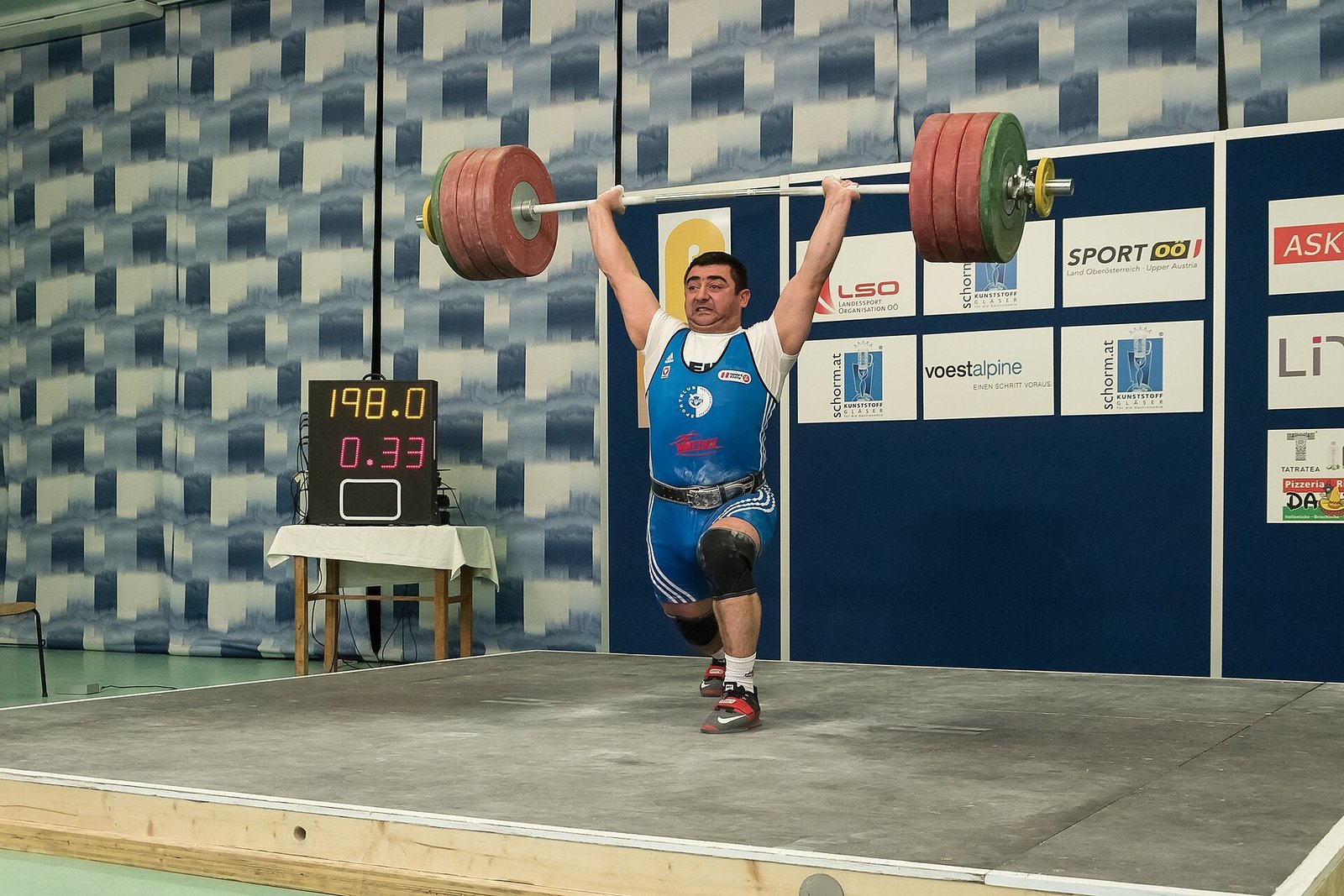
Photo: Isiwal / Wikimedia Commons
5. Synergee Bumper Plates — Best Thin Profile
Who it suits: lifters who load heavy and need bar space, and anyone who wants a low-bounce plate with a slimmer cut.
Synergee’s plates use a rubber polymer build with a 2-inch collar opening, at a 17.5-inch diameter. The thin profile is the selling point: the maker says you can fit five 45-pound plates plus two 15-pound plates on a standard sleeve — 510 pounds total — where thicker bumpers would run out of room sooner.
They are sold as singles, pairs, and sets — 160-pound, 230-pound, and 260-pound sets — so you can start small and add pairs rather than buying a full set at once.
Like most training bumpers, these are low-bounce rather than dead-bounce: the bar stays close to where it lands instead of rebounding across the platform.
Pros: thin profile fits more weight per sleeve; low-bounce rubber polymer; singles, pairs, and sets available; colour-coded options follow the standard Olympic scheme.
Cons: the Amazon product link below rests on a single source, so confirm the listing before ordering; one recent listing crawl showed no featured offers, so check availability; 17.5-inch diameter is slightly under the 450 mm competition standard.
👉 Check price on Amazon (please confirm the listing matches the Synergee bumper plate — its link is single-source, see the note in our research).
6. BalanceFrom Color Coded Bumper Plates — Best Value Set
Who it suits: lifters who want a colour-coded set at a budget price, with the full range in one purchase.
BalanceFrom’s plates use high-density rubber with a solid stainless steel insert, colour-coded by weight, with a 2-inch centre ring for Olympic bars. The 260-pound set includes pairs of 10, 15, 25, 35, and 45 pounds, and a 370-pound set adds the 55-pound pair.
Buyer ratings sit around 4.1 to 4.2 stars across hundreds to over a thousand reviews — solid mainstream acceptance for budget equipment, not competition-grade praise. Reviewers consistently mention a rubber smell when new, which fades with airing and use.
As with every budget set here, confirm the listing’s contents before ordering: some listings sell single plates, some pairs, and some full sets, and the price you see may apply to only one of those.
Pros: full 10-to-45 range in the 260-pound set, with a 55-pound option; colour-coded; steel inserts; widely sold with many buyer reviews.
Cons: no confident US product-page link was found, so this is a search link — check the listing before ordering; budget-grade accuracy, not a meet plate; rubber smell when new; packaging can arrive rough.
👉 Search for BalanceFrom Color Coded bumper plates on Amazon
How to Choose the Right Bumper Plates
Start with what you actually drop. Olympic lifts from overhead need true bumpers and a platform. Deadlifts need bumpers mainly to protect the floor and keep the bar at the right height. If you never drop the bar, iron plates are cheaper and thinner — bumpers are for droppers.
Then check your bar, your floor, and your sleeve space, in that order.
Bumper vs iron vs rubber-coated
Bumper plates are solid rubber, thick, and made to be dropped. Iron plates are thin, cheap per pound, and crack floors when dropped. Rubber-coated plates are iron plates with a rubber skin: quieter and kinder to floors than bare iron, but they are not drop plates — dropping them repeatedly can crack the coating and damage the core.
Do not buy rubber-coated plates expecting bumper behaviour. If the listing does not say the plates are made to be dropped, assume they are not.
Durometer and bounce
Durometer is a hardness scale for rubber. Harder rubber generally bounces less and lasts longer under drops; softer rubber is quieter but bouncier and wears faster.
In practice, most good training bumpers sit in a similar hardness band, and the maker’s bounce description — low, medium, or dead — tells you more than a single number. Competition plates bounce least of all, which is why a dropped competition bar stays put instead of chasing you across the platform.
Be sceptical of bounce claims with no drop test behind them. A plate that bounces wildly is a hazard in a small home gym, whatever the listing says.

Photo: Wikimedia Commons
Plate thickness and bar space
Bumper plates are much thicker than iron plates of the same weight. A 260-pound bumper set takes up far more sleeve length than 260 pounds of iron.
That is why thin-profile plates (like the Synergee pick) matter for heavy lifters: thicker plates run out of sleeve room sooner. Before ordering, check your bar’s loadable sleeve length against the total thickness of the set you plan to load.
It is also why competition plates are all the same diameter and as thin as the rubber allows: every plate, from 10 kilos up, holds the bar at the same pulling height.
Weight tolerance and colour coding
Tolerance is how far a plate’s real weight may sit from its marked weight. Training plates commonly sit around ±1% to ±3%; competition plates are tighter, often within a few grams of the stated weight.
For general training, ±3% is fine — your 45-pound plate weighing 44 or 46 pounds will not change your results. For competition preparation, tighter plates matter, because the bar you train with should match the bar you compete on.
Colour coding helps you load fast, but it is not universal in pounds. Kilogram competition colours are standard — red, blue, yellow, green, white — while pound sets vary by brand. Learn your own set’s chart.
IWF vs training plates
IWF plates are built to the International Weightlifting Federation’s competition standard: 450 mm diameter, tight weight tolerance, and the standard colour scheme. They are the plates you see at the Olympics.
Training plates borrow the look and the drop safety without the certification or the price. For a home gym, training plates are the right buy in almost every case — unless you compete, in which case training on plates that match your competition set is worth the premium.
Do not pay competition prices for a plate that is only competition-styled. If the listing does not claim IWF certification, it is a training plate, whatever the colours suggest.
Using bumper plates safely
Drop only on a platform or thick rubber mats, never on bare concrete, tiles, or a thin rug. Even the best bumpers cannot protect a floor they were never designed for.
Never drop a bar loaded with only small plates — 10s and 15s alone can bend or crack, because there is not enough rubber on the bar to absorb the impact. Load a heavier plate first, then the small ones outside it.
Lock your collars before every set, and check plates for cracks, loose hubs, or deep cuts before heavy work. A damaged plate is not worth a dropped bar.
If you have an injury, a bad back, or pain that keeps coming back, talk to a clinician or physiotherapist before training with heavy dropped lifts. This guide is general information only, not medical advice.
Frequently Asked Questions
Can I drop bumper plates on any floor?
No. Bumpers protect the bar and themselves, but the floor still takes the impact. Use a lifting platform or thick rubber mats. Bare concrete, tiles, and thin rugs are not dropping surfaces, even with good plates.
Do I need bumper plates if I never drop the bar?
Probably not. If you always lower the bar under control, iron plates are cheaper and thinner, so you fit more weight on the bar. Bumpers earn their price when the bar gets dropped — Olympic lifts, heavy deadlifts, and high-rep barbell work.
Why are bumper plates so thick?
Because rubber is less dense than iron, so a rubber plate needs more volume to reach the same weight. That thickness is also what absorbs the drop. The trade-off is sleeve space: a full bumper set fills a bar faster than the same weight in iron.
Can I mix bumper plates with iron plates?
Yes, with one rule: load the bumpers first, closest to the bar’s centre, and the iron outside them. The bumpers take the impact when the bar lands. Never put iron plates inside bumpers on a bar you plan to drop — the iron will hit the floor first.
Do bumper plates fit all barbells?
Almost all Olympic barbells, yes — every pick here uses a 2-inch centre hole. They will not fit 1-inch standard bars without an adapter, so check your bar’s sleeve diameter before ordering.
How long do bumper plates last?
It depends on the rubber, the hub, and how often you drop them. Virgin rubber with a steel hub outlasts crumb rubber, and plates dropped on a platform outlast plates dropped on concrete. Replace any plate with a cracked hub, a loose insert, or deep cuts — it is no longer absorbing drops the way it should.
Our Pick in One Line
If you want one answer: the REP Black plates are the best all-round buy because their virgin rubber, steel insert, and extra-thick 10s cover everything from Olympic lifts to heavy training — but if budget matters most, the Titan Economy line does the basic drop-safe job for less.
For the rest of your barbell setup, see our Olympic barbells guide and our barbell collars guide, and for starting a home gym from scratch, see our beginners equipment guide.
As an Amazon Associate, we earn from qualifying purchases made through links on this page, at no extra cost to you.
This guide is research-based: we compared verified buyer reviews and manufacturer specifications, and we did not buy or hands-on test these products. Prices and availability change, so check the listing before ordering. The training information here is general information only, not medical advice — if you have an injury or pain that keeps coming back, talk to a clinician first.