

Magnesium helps your muscles relax, your nerves fire normally, and your body make energy. Lifters lose it in sweat, and hard training raises the demand. A supplement can fill the gap when food falls short. This guide compares six of them on verified facts.
Every dose, form, and certification below comes from the maker’s label, a retailer listing, or Amazon — never from another roundup. Prices are dated, and conflicts between sources are printed with a †, not settled quietly. Nothing here was tested by us; we compared verified specifications.
If you take other supplements for training, read this alongside our best fish oil supplements for strength athletes — the same method, and the same honesty about prices and labels.
The short version: glycinate is the safest default, threonate is the priciest bet on the brain, and malate suits daytime use. Our top pick is Thorne’s bisglycinate powder. The full comparison — and the catches — is below.
Why Magnesium Matters for Sleep and Recovery

Photo: Ketut Subiyanto via Pexels
Magnesium is involved in more than 300 enzyme reactions in the body, including energy production and muscle function. That is the NIH’s figure, not a marketing line. It is also why a shortfall shows up first where lifters notice it: cramps, twitches, and restless nights.
The recommended daily allowance is 400–420 mg for men and 310–320 mg for women, from food and supplements combined. Most people get a good share from food — leafy greens, nuts, seeds, and whole grains. Training, sweat, and a low-magnesium diet can leave a gap.
Sleep is where magnesium gets the most attention. It helps regulate the nervous system and the sleep-wake cycle, which is why so many lifters take it at night. The honest position: the evidence that supplements improve sleep in healthy adults is modest, and no form has been proven best.
Recovery is the other half of the story. Magnesium supports normal muscle function, so it belongs in any conversation about soreness and cramps — with a caveat. Cramps have many causes, and magnesium only helps when a shortfall is one of them. It is not a cure-all.
The form matters more than the brand. Glycinate (bisglycinate) is magnesium bound to glycine — gentle on the stomach and the default for sleep. Malate binds it to malic acid and is usually taken in the daytime. Threonate (Magtein) is the brain-focused form, and the priciest.
One form to skip for sleep: magnesium oxide. It is cheap and common, but poorly absorbed, and the most likely to cause loose stools. None of our six picks is an oxide. If a bottle does not name its form, put it back.
Magnesium is one piece of a recovery stack, not the whole thing. Sleep, protein, and training load matter more than any capsule. For the rest of the stack, see our best creatine supplements — creatine is the one recovery supplement with the strongest evidence behind it.
How We Picked These 6
Photo: cottonbro studio via Pexels
We started with the forms that have a reason to exist: glycinate, malate, and threonate. Oxide and citrate were left out — oxide for poor absorption, citrate because it is mainly a laxative at the doses lifters use. Every pick names its form on the label.
Then we checked the dose. The label must state the elemental magnesium per serving — the number that matters — not just the weight of the whole compound. A ‘1,000 mg’ tablet can hold only 113 mg of elemental magnesium, as the NOW pick shows. That gap is the oldest trick on supplement labels.
Third-party testing came next. NSF Certified for Sport and USP Verified are the two marks we trust, because an independent lab checks what is actually in the bottle. Three of our six carry one of those marks. The other three are judged on their label transparency instead.
Price was compared per 200 mg of elemental magnesium, not per bottle — the only fair way to compare a 120 mg capsule with a 200 mg scoop. The table below shows the maths. The cheapest per 200 mg is Doctor’s Best at its brand-site price ($0.17); NOW is a close second at $0.19.
We also checked recalls. No pick in this guide has been recalled. The only recent magnesium recall we found was a batch of gummies with undeclared melatonin — a different product from a different maker, and not one of our six.
What we did not do: we did not run lab tests, and we did not run a sleep trial. No guide that claims to have tried six supplements in a week is telling the truth. What follows is verified specifications, honest prices, and the catches we found.
One more thing this guide is not: a diet plan. Food comes first — leafy greens, nuts, seeds, and whole grains carry most of the magnesium most people need. For the protein side of recovery, see our protein powders for muscle gain guide — magnesium helps your muscles relax, protein helps them rebuild.
The 6 Best Magnesium Supplements at a Glance
The table below is the whole guide on one screen. Read the ‘elemental mg’ column, not the big number on the front of the bottle. That column is what your body actually gets per serving.
Prices are what we saw, dated in the research notes — Amazon prices move, so check the listing before you buy. The ‘per 200 mg’ column is our own maths from the price and the elemental dose, so you can compare a powder with a tablet fairly.
A † next to a number means two sources disagree, and the article says so instead of picking one quietly. The NOW pick’s 113 mg is the clearest example — the NIH’s label file says 115 mg. Both numbers are printed in the research notes.
| Pick | Form | Elemental Mg / Serving | Servings | Price Seen | Per 200 mg |
|---|---|---|---|---|---|
| Thorne Magnesium Bisglycinate | Bisglycinate powder | 200 mg | 60 | $52 direct | $0.87 |
| Nature Made High Absorption Magnesium Glycinate | Glycinate capsules | 200 mg | 30 | $21.99 list; $10.62 S&S | $0.35–$0.73 |
| Momentous Magnesium L-Threonate | L-threonate (Magtein) | 145 mg | 30 | $49.99 | $2.30 |
| Pure Encapsulations Magnesium (Glycinate) | Glycinate capsules | 120 mg | 180 | ~$46.50 | $0.43 |
| Doctor’s Best High Absorption Magnesium | Glycinate-lysinate tablets | 200 mg | 120 | ~$21–$24 | $0.17–$0.20 |
| NOW Magnesium Malate | Malate tablets | 113 mg † | 180 | $19.50 (iHerb) | $0.19 |
1. Thorne Magnesium Bisglycinate — Best Overall
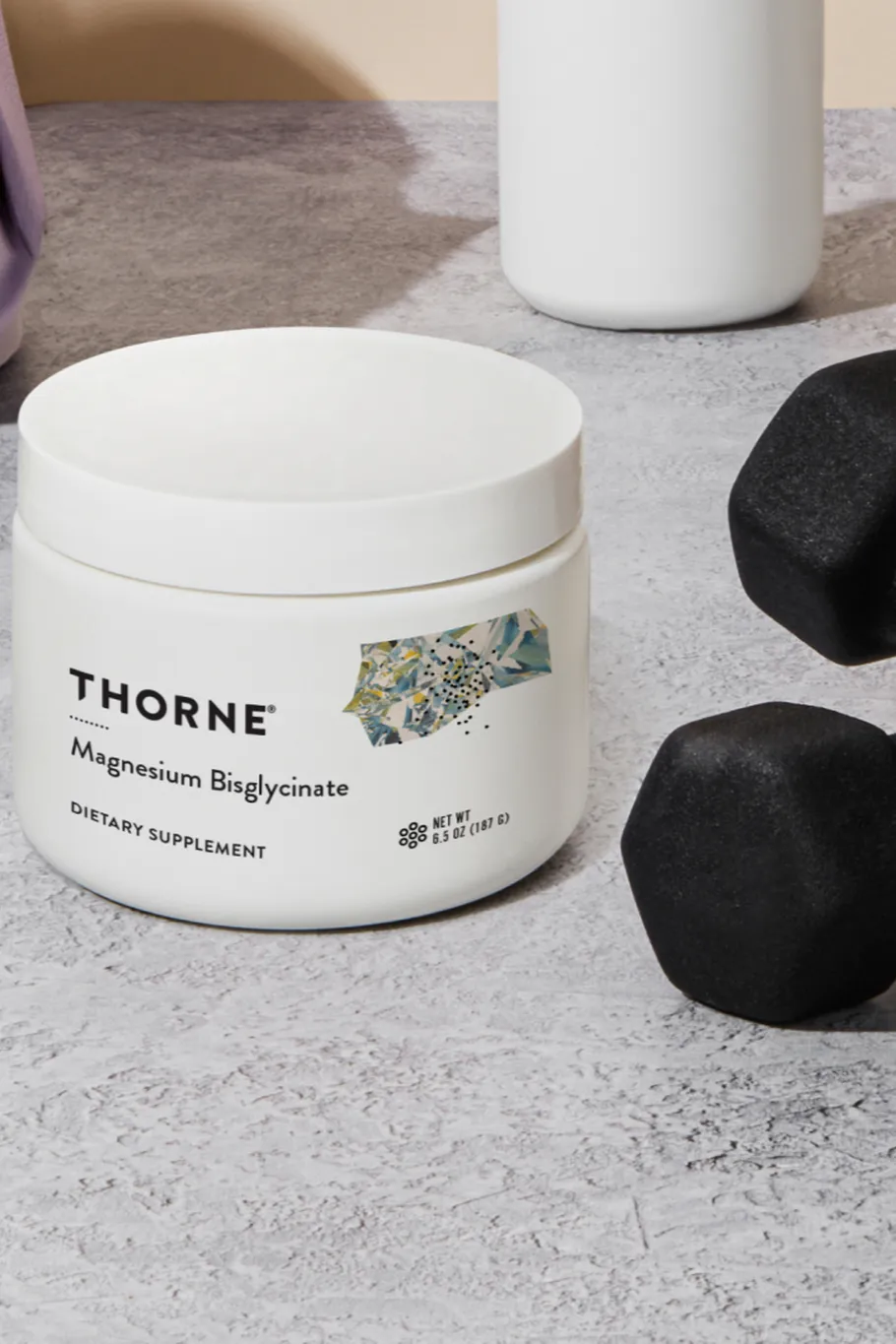
Photo: Nutrition Capital
Thorne’s bisglycinate powder is our top pick because it does the basics best: a full 200 mg per scoop, a form that is gentle on the stomach, and NSF Certified for Sport — the strictest third-party testing in this guide. No capsule in this guide matches that combination.
One scoop is 200 mg of elemental magnesium, and the tub holds 60 servings. The powder mixes into water, which suits anyone who dislikes swallowing capsules. The tub in our photo reads 6.5 oz (187 g) — that is the size the buy link below points to.
NSF Certified for Sport means an independent lab checks the product for banned substances and label accuracy — the standard pro sports teams use. Thorne lists three NSF entries for this product. That is the strongest testing story of any pick here, and the main reason it leads the guide.
✅ Pros
- full 200 mg per scoop
- NSF Certified for Sport
- powder form — easy to adjust the dose
- gentle bisglycinate form, easy on the stomach.
❌ Cons
- $0.87 per 200 mg is mid-pack, not cheap
- powder is less convenient than capsules when travelling
- the scoop weight disagrees between sources — see below.
Best for: lifters who want the strongest third-party testing and a dose they can adjust, and who do not mind mixing a powder at night.
May not fit: anyone who wants the cheapest magnesium per milligram, or a capsule they can take without water.
Price: $52 direct from Thorne (seen November 2026), which works out to $0.87 per 200 mg serving. Thorne also sells a 30-serving stick pack, but the buy link below is the 60-serving tub — do not confuse the two sizes.
What to watch: the scoop weight disagrees between sources. The current tub is 187 g, about 3.11 g per scoop, while the NSF listing names a 226.2 g package with a 3.77 g scoop. † The elemental dose is 200 mg either way, and that is the number that matters.
Check Price on Amazon: Thorne Magnesium Bisglycinate, 60 servings
2. Nature Made High Absorption Magnesium Glycinate — Best Value
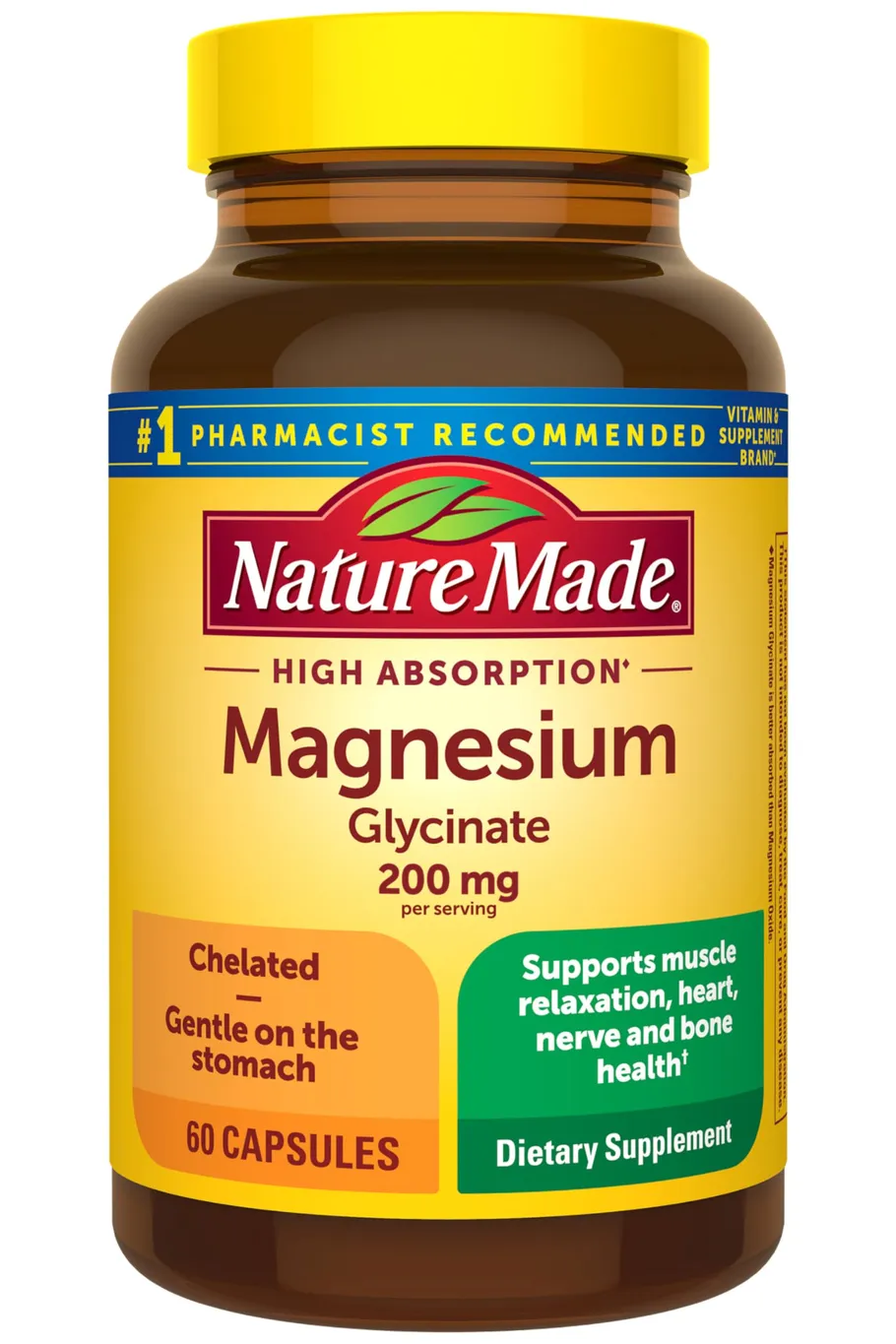
Photo: Nutricity
Nature Made is the best value here because it pairs a testing mark with a low price: 200 mg per serving, USP Verified, and about $0.35 per serving with Subscribe & Save. It is the pick for anyone who wants a trusted name from a drugstore shelf, without paying a premium for it.
Two capsules make one serving: 200 mg of elemental magnesium as magnesium glycinate. The bottle holds 60 capsules, so 30 servings. The label calls it ‘chelated — gentle on the stomach’, and glycinate is the form most often recommended for people with sensitive digestion.
USP Verified is the second of the two testing marks we trust. The USP checks the product’s identity, strength, and purity against its label — an independent check, not the maker’s own word. The seal sits on the side of the bottle, not the front our photo shows.
✅ Pros
- USP Verified
- full 200 mg per serving
- about $0.35 per serving with Subscribe & Save
- widely available in drugstores.
❌ Cons
- only 30 servings per bottle — you will reorder monthly
- the list price ($0.73 per 200 mg) is not the Subscribe & Save price
- two capsules per serving.
Best for: anyone who wants a verified product at the lowest price, and who is happy to set up Subscribe & Save.
May not fit: anyone who wants more than 30 servings per bottle, or who dislikes taking two capsules at once.
Price: list $21.99. Subscribe & Save showed $10.62 (52% off) on the Amazon page crawled in November 2025, and $11.20 in August 2026. † At the Subscribe & Save price, a 200 mg serving costs about $0.35; at list, about $0.73.
What to watch: the price you pay depends on Subscribe & Save. Without it, this pick costs more than twice as much per serving — and the bottle still only lasts a month. Set the subscription if you choose this one.
Check Price on Amazon: Nature Made High Absorption Magnesium Glycinate, 60 capsules
3. Momentous Magnesium L-Threonate — Best for Sleep and Focus
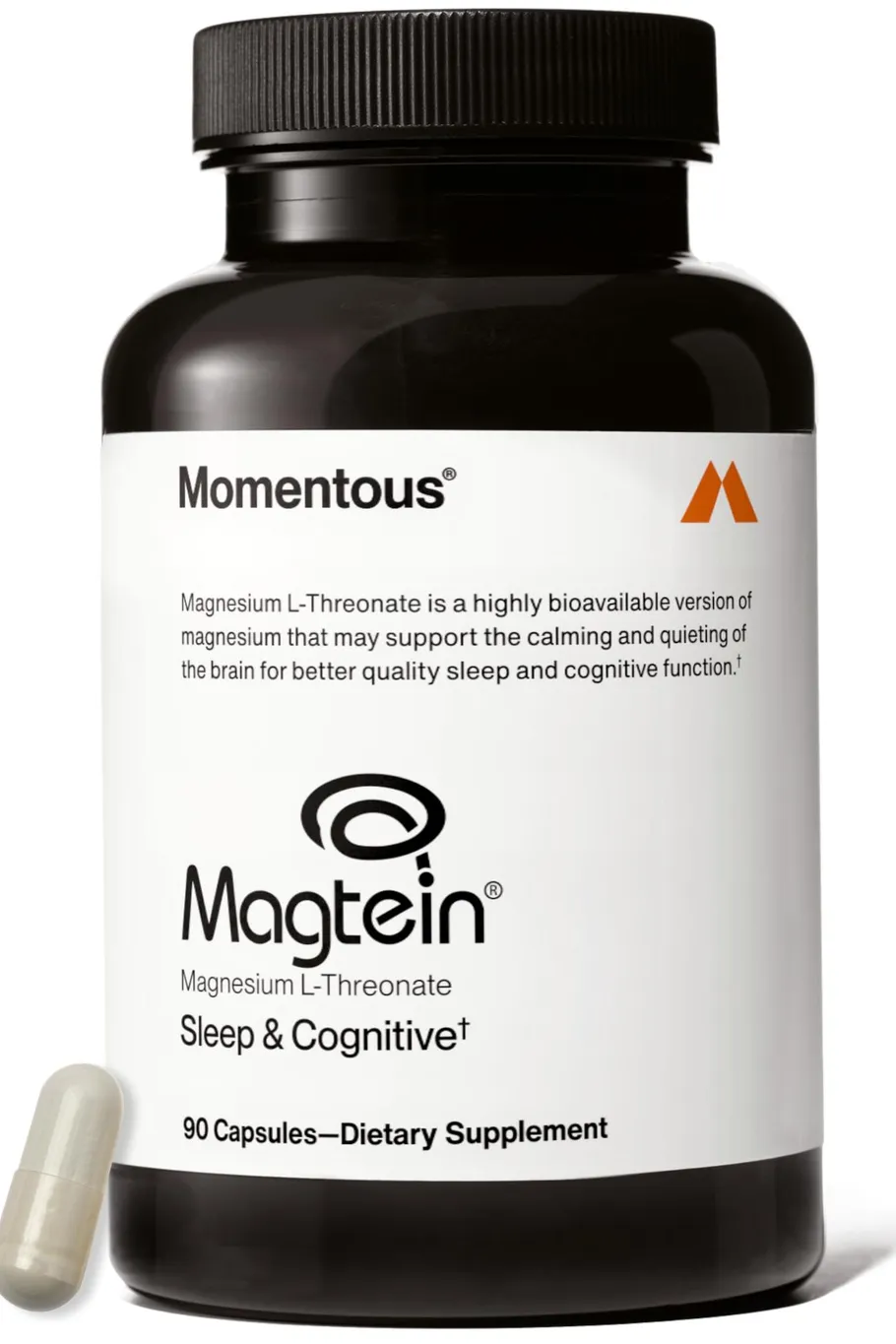
Photo: Oasis Health
Momentous L-Threonate is the brain-focused pick — the only one here built on Magtein, the patented form of magnesium L-threonate. It is also the most expensive per milligram in this guide, by a wide margin. Buy it for the form, not the value.
Three capsules make one serving: 2 g of Magtein, which the label lists as 145 mg of elemental magnesium. The bottle holds 90 capsules, so 30 servings. The label’s own words are ‘Sleep & Cognitive’ — the two reasons anyone buys this form.
NSF Certified for Sport covers this exact 90-count bottle (listing 1496111), so the testing story is solid. The brain claim is where honesty matters: the idea that threonate raises brain magnesium comes from animal studies. No human study has shown it raises brain magnesium.
✅ Pros
- NSF Certified for Sport
- the only Magtein pick here
- a genuine point of difference — no other form targets the brain the same way.
❌ Cons
- $2.30 per 200 mg — more than ten times the cheapest pick
- only 145 mg per serving, so it delivers less magnesium than the glycinate picks
- three capsules per serving.
Best for: lifters who specifically want the threonate form and are willing to pay for it — and who take it for focus and sleep, not for the cheapest magnesium.
May not fit: anyone buying on value, anyone who wants 200 mg or more per serving, or anyone who dislikes swallowing three capsules at night.
Price: $49.99 direct from Momentous ($37.49 on subscribe); $49.95 on Amazon (seen November 2026). A serving costs $1.67, and a 200 mg equivalent costs about $2.30 — the highest in this guide by far.
What to watch: lab certificates for this product show 178.8–191.8 mg of elemental magnesium per serving — above the 145 mg on the label. † The label understates the content. We print the label figure, and the lab finding, so you see both.
Check Price on Amazon: Momentous Magnesium L-Threonate, 90 capsules
4. Pure Encapsulations Magnesium (Glycinate) — Best for Sensitive Stomachs
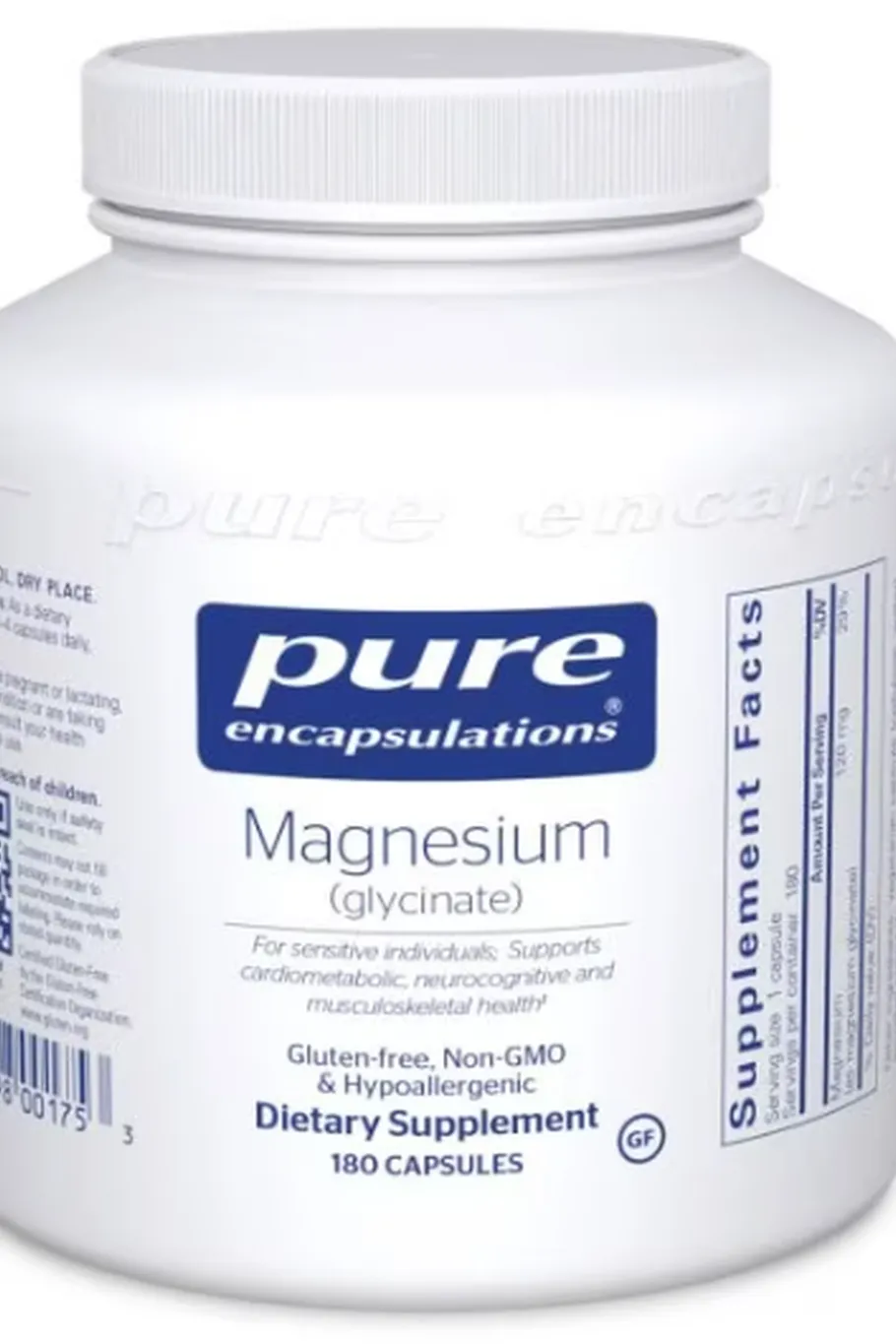
Photo: Pure Market
Pure Encapsulations is the pick for sensitive stomachs — and for people who want to control their dose one capsule at a time. Each capsule holds only 120 mg, so you can take one, two, or three. That flexibility is the whole point of this bottle.
One capsule is 120 mg of elemental magnesium as magnesium glycinate, and the bottle holds 180 capsules. The label suggests 1–4 capsules daily with food. Two capsules give 240 mg — the closest this bottle gets to the 200 mg serving the other picks use.
The formula is short on purpose: magnesium glycinate, a vegetarian capsule, and a small antioxidant — nothing else. It is gluten-free, non-GMO, and hypoallergenic, and the label says so plainly. Fewer ingredients means fewer things to react to.
✅ Pros
- flexible 120 mg capsules — dose your way
- hypoallergenic and free of common allergens
- third-party tested (Eurofins/Silliker)
- 180 capsules per bottle.
❌ Cons
- $0.43 per 200 mg — more than double the cheapest pick
- an independent metals tester found lead in the capsules and did not recommend the product
- no NSF or USP mark on the label.
Best for: anyone with a sensitive stomach or allergies, and anyone who wants to start low and raise the dose one capsule at a time.
May not fit: anyone buying on price, or anyone who wants a 200 mg serving in a single capsule.
Price: about $46.50 on Amazon (seen August 2026); another tracker recorded $44.60. A capsule costs about $0.26, and a 200 mg equivalent costs about $0.43. The bottle lasts 90 days at two capsules a day.
What to watch: independent metals tester Tamara Rubin found lead in these capsules, ranked the product below Doctor’s Best, and did not recommend it. That finding sits against the brand’s own third-party testing. We print both, so the choice is yours.
Check Price on Amazon: Pure Encapsulations Magnesium (Glycinate), 180 capsules
5. Doctor’s Best High Absorption Magnesium — Best Budget
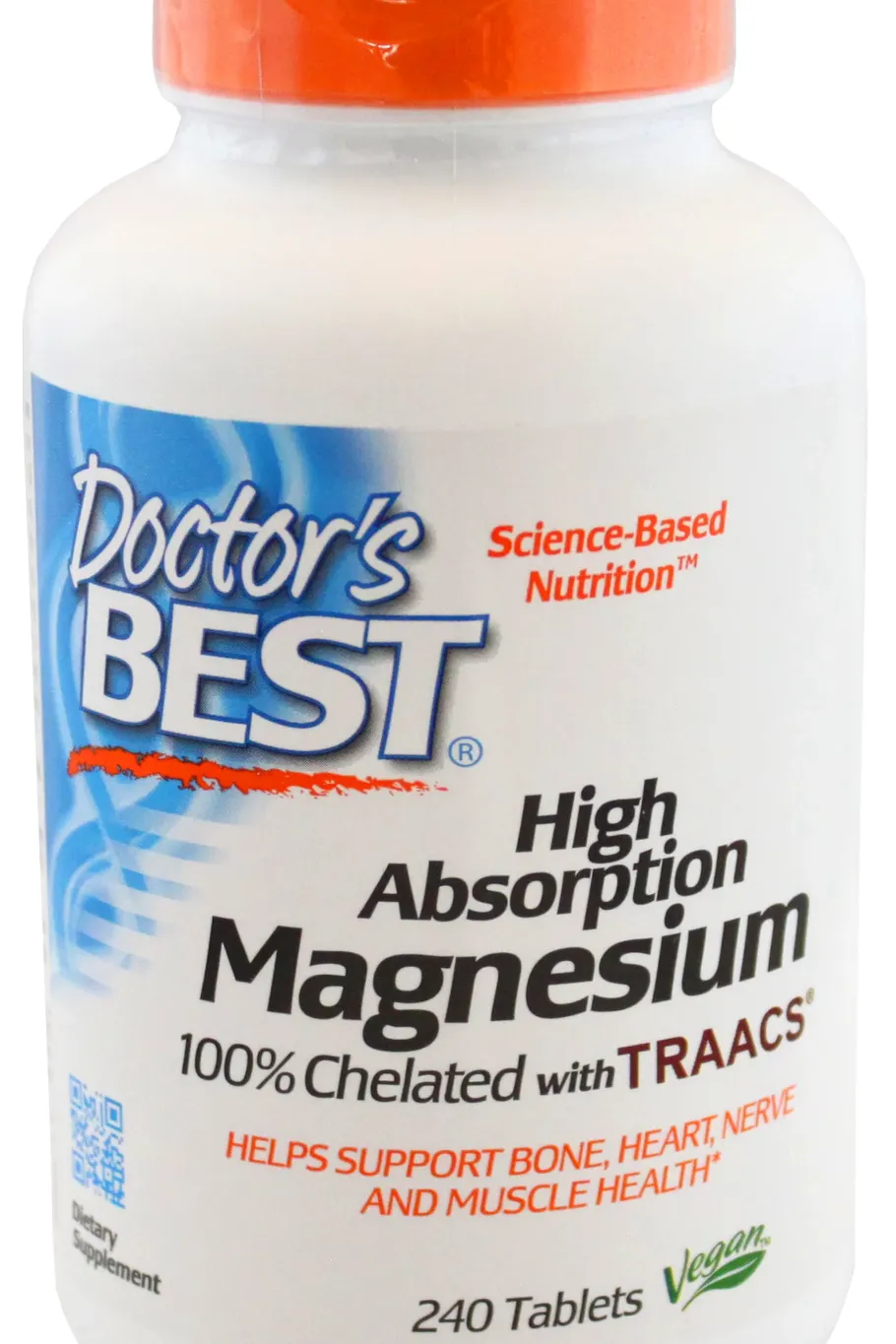
Photo: H-E-B
Doctor’s Best is the cheapest magnesium per milligram in this guide at its brand-site price. The trick is the tablet: 100 mg each, so you control the dose in 100 mg steps. Two tablets make the standard 200 mg serving.
The form is a glycinate-lysinate chelate made with Albion’s TRAACS process — magnesium bound to two amino acids, glycine and lysine. The label reads ‘100% Chelated with TRAACS’. The brand claims the chelate absorbs ‘up to 6×’ better; that is the brand’s claim, not a measured result.
The bottle holds 240 tablets, which is 120 servings at two tablets a day — four months of magnesium. No other pick here lasts that long per bottle. It is vegan, non-GMO, gluten-free, and soy-free, and the tablets are unflavoured.
✅ Pros
- cheapest per 200 mg at the brand price ($0.17)
- 240 tablets — four months per bottle
- flexible 100 mg tablets
- vegan and free of common allergens.
❌ Cons
- tablets are large, and some people find them hard to swallow
- no NSF or USP mark
- the label’s directions would take you over the daily supplement limit — see Safety.
Best for: anyone who wants the cheapest honest magnesium and a bottle that lasts four months.
May not fit: anyone who struggles with large tablets, or anyone who wants an NSF or USP mark on the label.
Price: $20.99 on the brand’s site; Amazon showed about $23.99 (checked 11 November 2026). A 200 mg serving costs $0.17 at the brand price and $0.20 at the Amazon price — the lowest in this guide at the brand price.
What to watch: the label says ‘take 2 tablets twice daily’ — that is 400 mg a day, above the NIH’s 350 mg daily limit for magnesium supplements. Take one 2-tablet serving (200 mg) unless a clinician tells you otherwise.
Check Price on Amazon: Doctor’s Best High Absorption Magnesium, 240 tablets
6. NOW Magnesium Malate — Best Malate for Daytime
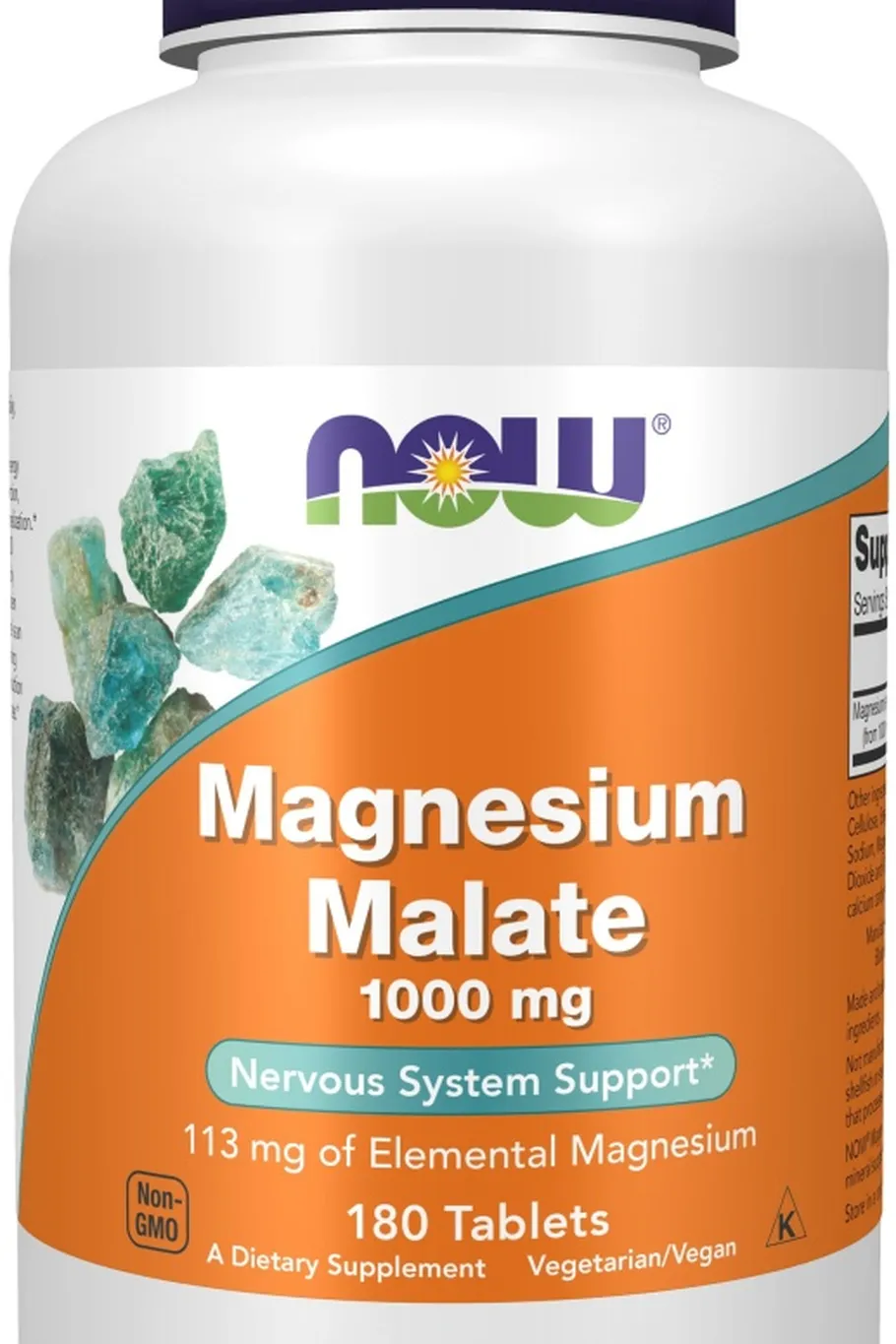
Photo: Kaspi.kz
NOW Magnesium Malate is the daytime pick in this guide. Malate is the form most often taken in the morning — it pairs magnesium with malic acid, a compound your cells use to make energy. Take it with breakfast, not at bedtime.
One tablet holds 1,000 mg of magnesium malate — but only 113 mg of that is elemental magnesium. † The bottle holds 180 tablets. The label suggests one tablet three times a day with food, which adds up to 339 mg — just under the 350 mg daily supplement limit.
This is the simplest label in the guide: one ingredient, one form, no blend and no proprietary mix. It is non-GMO and vegetarian/vegan. The trade-off is the dose — at 113 mg a tablet, you need two tablets to reach 200 mg, and three to reach the label’s full daily amount.
✅ Pros
- cheapest malate here at $0.19 per 200 mg
- simple one-ingredient label
- 180 tablets per bottle
- the label’s full daily dose stays under the 350 mg limit.
❌ Cons
- only 113 mg per tablet — the lowest dose per unit here
- no NSF or USP mark
- Amazon US had no featured offers when we checked, so the price below comes from iHerb.
Best for: lifters who want a malate for daytime energy, and who are happy taking a tablet with each meal.
May not fit: anyone who wants a night-time sleep supplement, or a 200 mg serving in a single tablet.
Price: $19.50 on iHerb (seen November 2026). Amazon US showed no featured offers when we checked, so buy there only if a seller appears. At the iHerb price, a 200 mg equivalent costs about $0.19.
What to watch: the elemental dose disagrees between sources. The current label reads 113 mg, while the NIH’s label file (dated 23 May 2024) reads 115 mg. † We print the label in our photo — 113 mg — and note the difference.
Check Price on Amazon: NOW Magnesium Malate 1000 mg, 180 tablets
How to Choose the Right Magnesium
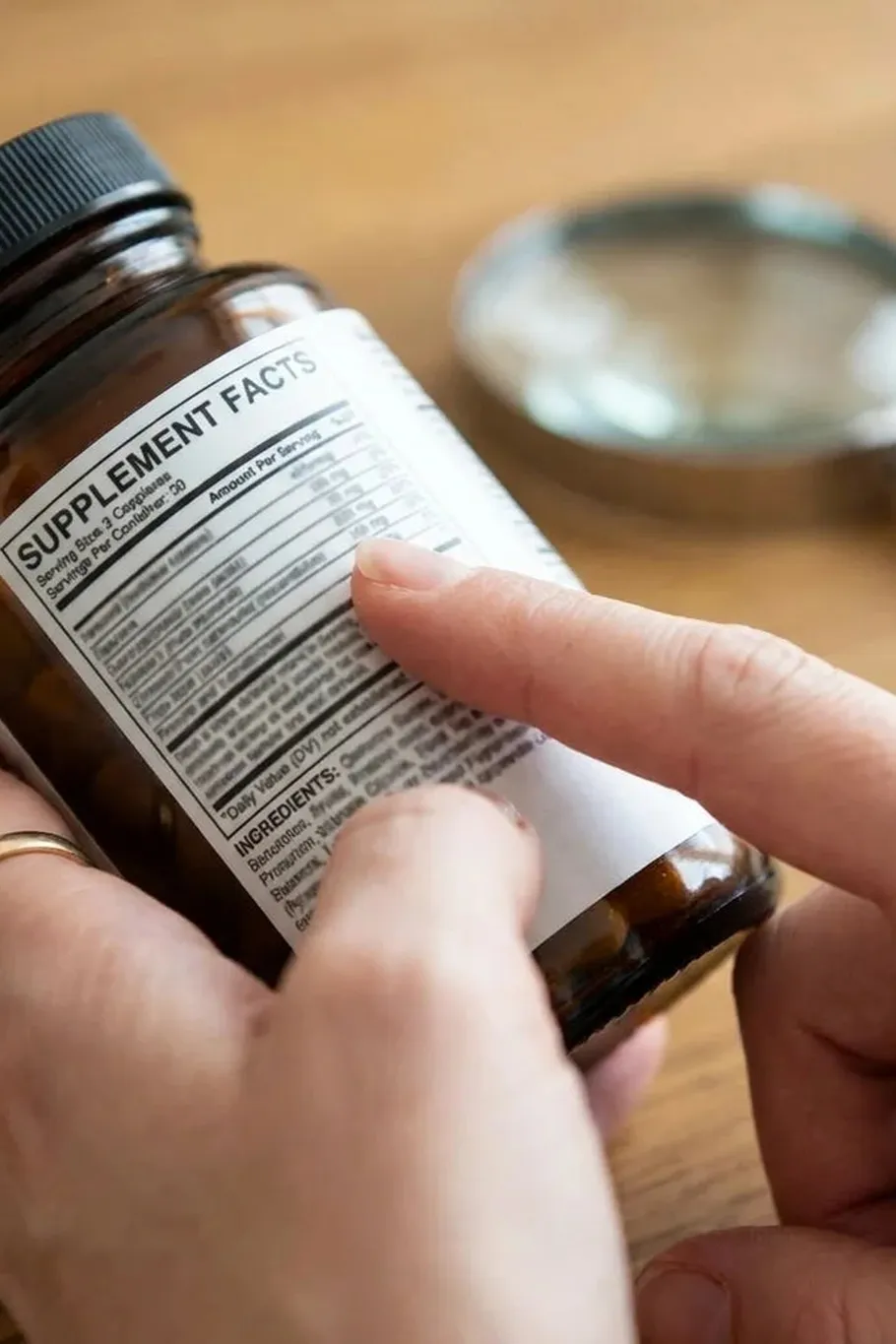
Photo: Verity
Start with the form, not the brand. For sleep, glycinate is the default — gentle, well absorbed, and the form in four of our six picks. For daytime energy, malate. For the brain-focused bet, threonate — with the honest caveat that its brain claim rests on animal studies.
Then read the Supplement Facts panel — the back of the bottle, not the front. The front says ‘1,000 mg’; the panel says how much of that is elemental magnesium. If the panel does not state the elemental amount, the maker is hiding the only number that matters.
Next, check the serving size against the dose you want. A bottle that says ‘200 mg per serving’ but defines a serving as two capsules is fine — you just take two. A bottle that hides its serving size behind a blend is not fine. Our table shows the serving size for every pick.
Look for a third-party mark: NSF Certified for Sport or USP Verified. These are independent checks that the bottle holds what the label claims. Three picks here carry one of those marks. For the other three, a short, transparent ingredient list is the next best sign.
Compare the price per 200 mg, not per bottle — the table does the maths for you. A cheap bottle with a small dose can cost more per day than a dear bottle with a full dose. The same rule works for any supplement, including our 6 best joint supplements for inflammation.
Match the form to the time of day. Glycinate and threonate are evening picks — take them 30–60 minutes before bed, as most lifters do. Malate is the morning pick. Taking malate at night will not harm you, but it misses the point of the form.
Avoid blends that do not break down their contents. A label that lists ‘magnesium complex 500 mg’ without saying how much is glycinate, how much is oxide, and how much is elemental is asking you to trust it blind. None of our six picks hides behind a blend.
Finally, give it time. Magnesium is not a sleeping pill — it will not knock you out on night one. Most lifters who notice a difference report it after one to two weeks of steady use. If nothing changes in a month, the form or the dose is probably wrong for you.
Safety and Side Effects
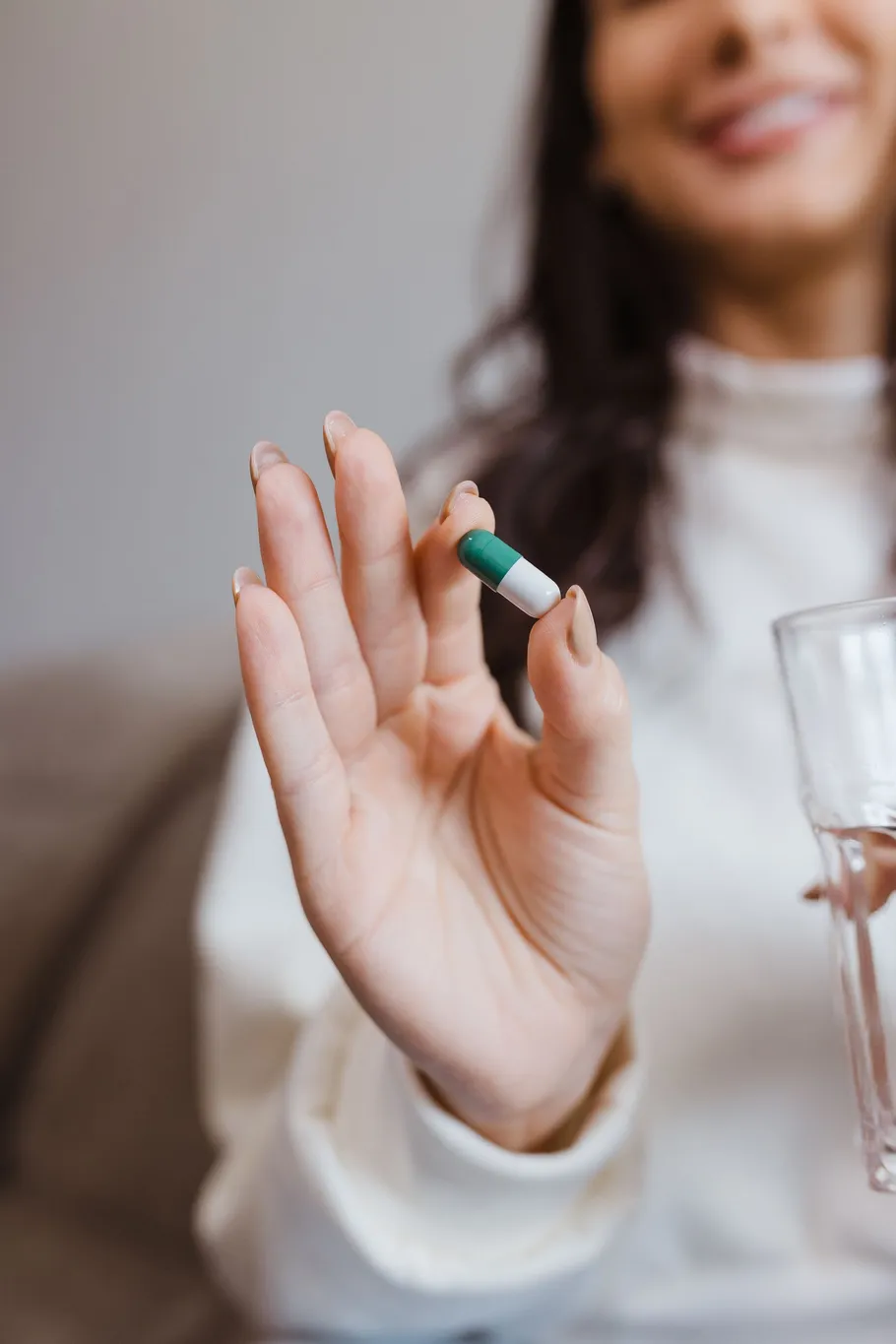
Photo: Jonathan Borba via Pexels
The NIH sets the upper limit for magnesium from supplements at 350 mg a day for adults. That limit covers supplements and medicines only — magnesium from food does not count toward it. Every pick in this guide can be taken under that limit at its normal serving.
The most common side effect is loose stools — the reason the limit exists. Glycinate is generally the gentlest form, while oxide and citrate are the most likely to upset the stomach. If a dose gives you loose stools, lower it before you switch forms.
Three labels in this guide need a warning. Doctor’s Best says ‘take 2 tablets twice daily’ — 400 mg a day, above the limit. Thorne’s Amazon listing says ‘one to two times daily’ — up to 400 mg. NOW’s full daily dose is 339 mg, just under the limit.
The rule is simple: count only the supplement, and stay at or under 350 mg a day unless a clinician tells you otherwise. One normal serving of any pick here is 113–200 mg — well inside the limit. It is the second serving, or a second magnesium product, that pushes you over.
Magnesium can interact with some medicines, including certain antibiotics and blood-pressure medicines. If you take prescription medicine, ask a clinician or pharmacist before adding a supplement. Bring the bottle — the form and the dose are what they need to see.
People with kidney disease should be careful — the kidneys clear magnesium, and weak kidneys clear it slowly. Anyone who is pregnant or breastfeeding should ask a clinician first. This guide is general information, not medical advice, and it does not replace a clinician’s judgement.
Timing matters too. Magnesium is an evening supplement; what you take before training is a different question. For the morning side of your supplement routine, see our top 10 pre-workout supplements — and keep the two routines separate.
One last note on recalls: no pick in this guide has been recalled. The only recent magnesium recall we found was a batch of gummies with undeclared melatonin, from a different maker — not one of our six, and not a tablet, capsule, or powder.
Frequently Asked Questions

Photo: Andrea Piacquadio via Pexels
Which form of magnesium is best for sleep?
Glycinate is the usual default — gentle, well absorbed, and the form in four of our six picks. Threonate is the brain-focused alternative, but its brain claim rests on animal studies. No form has been proven best for sleep in human trials, so pick the one you tolerate and can afford.
How much magnesium should I take each day?
The recommended daily allowance is 400–420 mg for men and 310–320 mg for women, from food and supplements together. The upper limit for supplements alone is 350 mg a day. One normal serving of any pick here is 113–200 mg — inside the limit, with food on top.
When should I take magnesium?
Take glycinate or threonate 30–60 minutes before bed — that is the routine most lifters use. Take malate in the morning, with food. Taking magnesium with food also helps if a dose upsets your stomach.
Can I take magnesium with creatine and protein?
Yes. Magnesium, creatine, and protein work through different pathways, and there is no known conflict between them. Take creatine and protein around training, and magnesium at night — that is the simplest routine, and the one most lifters follow.
Does magnesium help muscle cramps?
Sometimes — when a shortfall is part of the cause. Cramps also come from dehydration, fatigue, and overuse, and magnesium will not fix those. If cramps are frequent or severe, see a clinician rather than raising the dose on your own.
Is magnesium safe with medication?
Usually, but not always. Magnesium can interact with certain antibiotics and blood-pressure medicines, and people with kidney disease need extra care. Tell your clinician or pharmacist about every medicine you take before starting a supplement.
As an Amazon Associate, we earn from qualifying purchases made through the links in this guide, at no extra cost to you. Prices were seen on the dates noted in each section and change often — check the listing before you buy.
This guide is general information, not medical advice. It does not diagnose, treat, or prevent any disease. If you take prescription medicine, are pregnant or breastfeeding, or have kidney disease, ask a clinician before taking a magnesium supplement.
The bottom line: Thorne’s bisglycinate powder leads on testing, Nature Made wins on value, and Doctor’s Best is the cheapest per milligram at its brand-site price. Any of the six is an honest pick — the wrong choice is a bottle that does not name its form or its elemental dose.
Magnesium helps recovery, but it does not replace training, sleep, or food. Keep lifting, keep the routine simple, and let the supplement do the small job it is good at. For the training side, see our best competition kettlebells for home gyms.