

Your rest between sets was meant to be ninety seconds. It is now four minutes, and you are scrolling. That is what training without a timer looks like. ⏱️
A gym timer — a wall LED clock, a portable interval timer, or an app-paired display — counts your work, counts your rest, and beeps when the next round starts, so the session runs on the plan instead of on feeling.
But let us be plain from the start: a timer keeps intervals and rest honest, but it does not make a workout safe by itself, it does not replace proper programming or coaching, and it does not fix a workout that is too intense for the lifter.
Used the right way — intervals programmed before the session, rest timed instead of guessed, volume built up gradually — a timer is one of the cheapest discipline tools a home gym can own.
How We Picked These Timers
Photo: Taco fleur / Wikimedia Commons
This guide is research-based. We did not buy or hands-on test these timers, and we do not claim otherwise.
We compared verified buyer reviews and manufacturer specifications, and we checked each product’s Amazon listing status through search results and listing trackers.
We picked 6 timers that are genuinely sold and cover different needs: an app-paired wall clock, a large wall display, a budget wall timer, a loud large display, a budget portable timer, and a magnetic portable timer.
Prices are not quoted in this guide because they change often. The check-price links take you to the current listing, where you can see the latest price and availability.
Availability and colour options vary, so if your option shows as unavailable, check the listing’s other options before switching products.
One note on size: digit height matters more than the timer’s overall length. A timer with 2.9-inch digits is readable from across a garage; a timer with 1.5-inch digits is readable from a few steps away. Buy for the distance you actually train at.
Quick Comparison
Photo: Tpikonen / Wikimedia Commons
| Timer | Type | Digits | Best for |
|---|---|---|---|
| GymNext Flex Timer Home Edition | Wall LED, app-paired | 2.3 in | Best overall / app-paired |
| LUCORB 15-Inch Gym Timer | Wall LED, remote | 2.9 in | Best wall display |
| BTBSIGN 2.3-Inch LED Timer | Wall LED, remote | 2.3 in | Best budget wall timer |
| ANJANK 15-Inch Gym Timer | Wall LED, remote | 2.6 in | Best loud buzzer |
| Seesii LED Gym Timer | Wall LED, remote | 1.5 in | Best budget portable |
| ANJANK Small Portable Gym Timer | Portable, magnetic | Compact | Best portable |
1. GymNext Flex Timer Home Edition — Best Overall / App-Paired
Photo: Larry D. Moore / Wikimedia Commons
Who it suits: lifters who run varied interval training — EMOM, Tabata, boxing rounds, conditioning circuits — and want to programme it from a phone instead of a remote.
GymNext’s Flex Timer Home Edition is a 13-inch wall LED clock with 2.3-inch digits — six digits, two blue and four red — controlled by Bluetooth from a phone app. The app offers 11 timer modes, including standard, round, interval, Tabata, EMOM, sets with rest, stopwatch, multi-segment, shot clock, scoreboard, and beep test.
The buzzer is adjustable up to 95 decibels, and the maker rates viewing distance up to 30 feet. Mounting brackets and a power supply are included, and the app works on its own without the display if you want to try the programming first.
Pros: the most polished interval programming here, from a phone app; 11 timer modes cover almost any session; adjustable buzzer up to 95 decibels; 30-foot viewing distance; mounting brackets included.
Cons: recent listing crawls showed no featured offers available, so check availability before ordering; the most expensive approach here — overkill if you only need a countdown; needs a phone nearby for full programming.
👉 Check price on Amazon (check availability — recent crawls showed no featured offers).
2. LUCORB 15-Inch Gym Timer — Best Wall Display
Photo: IrishMalcolm / Wikimedia Commons
Who it suits: garage and home-gym lifters who want one large, readable wall clock with a remote, and no app dependence.
LUCORB’s 15-inch timer measures 15 by 4 by 1.2 inches, with 2.9-inch digits — the largest digits in this guide — and 6 brightness levels plus an automatic dimming sensor. An interval progress bar shows rounds on the left and remaining time on the right.
It carries 4 preset programmes — Tabata, HIIT, and two Fight Gone Bad formats — plus 9 custom interval plans, and a loop button for EMOM countdowns up to 99 rounds. It also works as a 12/24-hour clock, countdown, count-up, stopwatch, and alarm clock, and the remote runs it from across the room.
Pros: largest digits here at 2.9 inches; progress bar shows rounds and remaining time at a glance; 4 presets plus 9 custom plans; EMOM loop up to 99 rounds; auto-dimming for bright and dark rooms.
Cons: a second LUCORB 15-inch listing circulates under a different model number, so confirm the listing matches the 15-inch timer before ordering; it needs mains power — the battery only stores settings during an outage; a budget brand, not a premium equipment maker.
👉 Check price on Amazon (please confirm the listing matches the LUCORB 15-inch timer — a second similar listing circulates, see the note in our research).
3. BTBSIGN 2.3-Inch LED Timer — Best Budget Wall Timer
Photo: Artur Andrzej / Wikimedia Commons
Who it suits: lifters who want the classic small wall timer — Tabata, Fight Gone Bad, and custom intervals — at the lowest cost in this guide.
BTBSIGN’s 2.3-inch timer is an 11-inch wall clock with bright red and blue LED digits, run entirely by remote. One key starts Tabata — 20 seconds work, 10 seconds rest, 8 rounds — and one key starts Fight Gone Bad, in 5-round or 3-round versions.
Beyond the presets, it stores up to 10 workout plans, each with up to 9 custom intervals of work and rest, and it works as a normal clock, countdown, count-up, and stopwatch down to hundredths of a second.
Pros: one-key Tabata and Fight Gone Bad presets; 10 stored plans with custom intervals; stopwatch to hundredths; compact 11-inch size for small gyms; long-running budget pick.
Cons: 2.3-inch digits suit a small gym, not a large room — check your viewing distance first; it runs only by remote, so a lost remote stops the session; some buyers report inconsistent remote responses.
4. ANJANK 15-Inch Gym Timer — Best Loud Buzzer
Photo: U.S. Navy / Wikimedia Commons
Who it suits: lifters who train with music on, or in a noisy garage, and need a buzzer they will actually hear.
ANJANK’s 15-inch timer measures 15 by 4 inches, with 2.6-inch digits and 5 brightness levels. Its buzzer reaches 110 decibels at maximum, with 12 volume levels including mute, so it cuts through music without being stuck at full volume.
It covers Tabata, Fight Gone Bad, EMOM loop countdowns up to 99 rounds, 9 custom interval plans, countdown, count-up, and stopwatch, all by remote from 40 to 50 feet. It wall-mounts, stands on a table with a foldable stand, or fixes to a tripod, and it runs from a DC adapter or a USB-C power bank.
Pros: loudest buzzer here at 110 decibels, with 12 volume levels; large 2.6-inch digits; wall, table, or tripod mounting; USB-C power-bank use for outdoor sessions; remote range up to 40–50 feet.
Cons: recent listing crawls showed no featured offers available, so check availability before ordering; a second similar ANJANK 15-inch listing circulates — confirm the listing before ordering; like most wall timers, batteries only preserve settings, they do not run it.
👉 Check price on Amazon (check availability — recent crawls showed no featured offers — and confirm the listing matches the 15-inch timer).
5. Seesii LED Gym Timer — Best Budget Portable
Photo: Singlespeedfahrer / Wikimedia Commons
Who it suits: lifters who want the cheapest timer that still covers intervals, and who train in more than one place.
Seesii’s LED timer is an 11.5-by-4-inch wall clock with 1.5-inch digits, run by remote, with countdown, count-up, stopwatch, and custom interval training. It runs from a wall outlet or a USB power bank, so it moves between rooms, garages, and outdoor sessions without a socket hunt.
The display brightness is adjustable, the buzzer is rated at 85 decibels, and four sizes are offered, so the same timer suits a small room or a larger garage depending on the size chosen.
Pros: cheapest approach here; power-bank compatible for portable use; remote control; countdown, count-up, stopwatch, and custom intervals; several sizes offered.
Cons: no confident US product-page link was found, so this is a search link — check the listing before ordering; 1.5-inch digits suit short distances only; sources disagree on the number of brightness levels, so the article states only that brightness is adjustable; one roundup notes it can drift by seconds over long sessions.
👉 Search for Seesii LED gym timer on Amazon
6. ANJANK Small Portable Gym Timer — Best Portable

Photo: SAgbley / Wikimedia Commons
Who it suits: lifters who want a timer that sticks to a rack, travels in a bag, and runs for days without a socket.
ANJANK’s small portable timer is a compact magnetic clock with a built-in battery rated up to 40 hours on a full charge, plus a remote. The magnet fixes it to a rack, a fridge, or any steel surface, and it works as a 12/24-hour clock as well as a workout timer.
It covers count-up, countdown, stopwatch, Tabata, Fight Gone Bad, EMOM loop countdowns, and 3 custom interval modes where work time, rest time, and rounds are set by remote.
Pros: up to 40 hours of battery on a charge; strong magnet for rack mounting; genuinely portable — no socket, no wall; remote control; Tabata, Fight Gone Bad, EMOM, and custom intervals.
Cons: the Amazon product link below rests on a single source, so confirm the listing before ordering; only 3 custom modes, against 9 on the larger timers; a small display, so it suits one lifter at close range, not a whole class.
👉 Check price on Amazon (please confirm the listing matches the ANJANK small portable magnetic timer — its link is single-source, see the note in our research).
How to Choose the Right Gym Timer
Photo: Nenad Stojkovic / Wikimedia Commons
Start with where you train. A fixed wall timer suits one garage; a portable timer suits a lifter who trains in several places; an app-paired timer suits a lifter who programmes varied sessions in advance.
Then check the distance: measure from the timer’s wall to the furthest point you train at, and buy digits big enough to read from there.
Timer type: wall LED vs portable vs app-paired
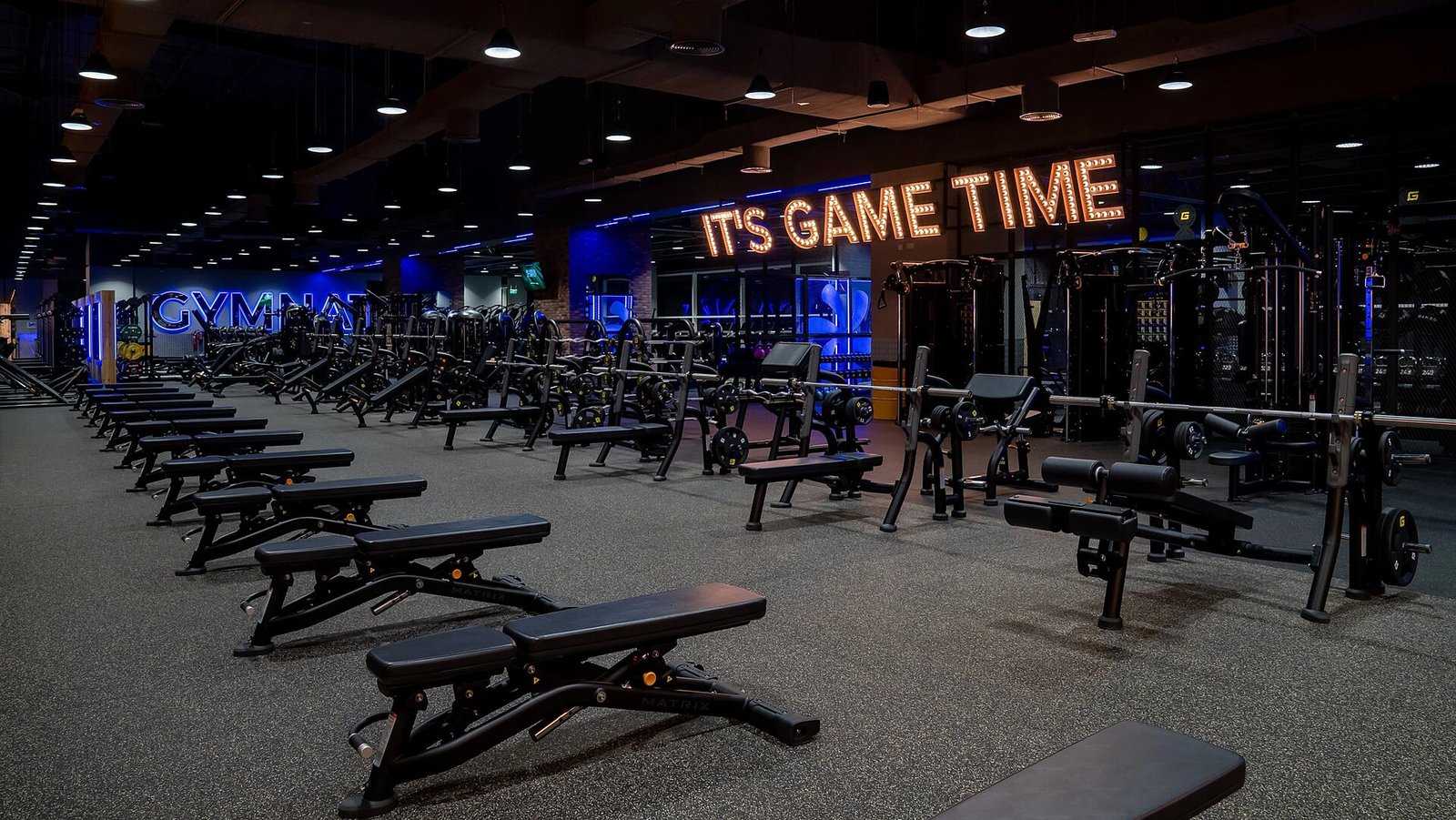
Photo: GymNation / Wikimedia Commons
Wall LED timers (LUCORB, BTBSIGN, ANJANK 15-inch) hang on the wall, run from mains power, and are controlled by remote. Best for a fixed gym, worst for travel, and the default choice for most home gyms.
Portable timers (Seesii, ANJANK small) run from a battery or power bank and move with you. Best for outdoor sessions, classes, and shared spaces, worst for whole-room visibility.
App-paired timers (GymNext) pair a wall display with a phone app. Best for varied programming — EMOM, Tabata, circuits, custom rounds — worst for lifters who want a timer that just works with a remote.
Display size and visibility

Photo: Mohammad Hassanzadeh / Wikimedia Commons
Digit height is the honest number: 2.9 inches (LUCORB) reads across a garage, 2.6 inches (ANJANK 15-inch) reads across a large room, 2.3 inches (GymNext, BTBSIGN) reads across a small gym, and 1.5 inches (Seesii) reads from a few steps away.
Brightness matters as much as size. A dim display in a bright garage is unreadable whatever the digits, so adjustable brightness — and auto-dimming, on the LUCORB — is worth having.
Colour helps too: red and blue digits against a dark face read better at a glance than white digits in daylight, which is why nearly every timer here uses them.
Interval programming: Tabata, EMOM, custom rounds
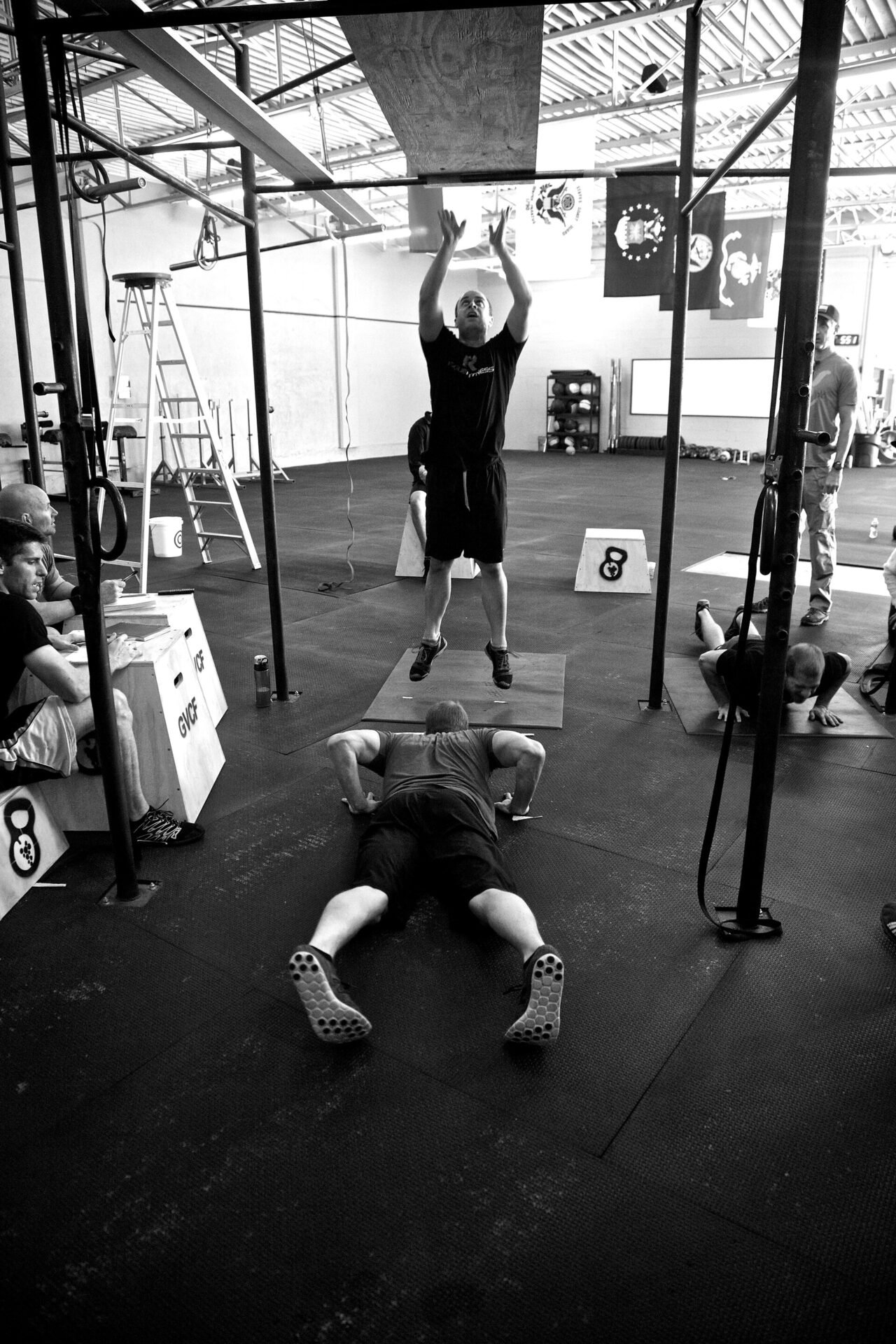
Photo: Travis Isaacs / Wikimedia Commons
Tabata means 20 seconds of work and 10 seconds of rest, for 8 rounds — every timer here offers it as a preset, and it is the fastest way to start.
EMOM means every minute on the minute: a task starts at the top of each minute, and whatever time is left is rest. The LUCORB, ANJANK 15-inch, and ANJANK portable timers offer EMOM loop countdowns up to 99 rounds.
Custom rounds are where the timers differ: GymNext offers 11 app modes, BTBSIGN stores 10 plans of 9 intervals, LUCORB and ANJANK 15-inch store 9 plans, and the ANJANK portable stores 3. If your sessions repeat the same scheme, stored plans matter more than preset count.
Power and mounting

Photo: Cpl. Reece Lodder / Wikimedia Commons
Most wall timers run from mains power, with batteries that only preserve settings during an outage — they do not run the display. Check for a socket near the mounting spot before ordering.
Portable timers run from a built-in battery (ANJANK small, up to 40 hours) or a USB power bank (Seesii), which is what makes outdoor and multi-room training possible.
Mounting is simple on most timers: wall keyholes, brackets, or a foldable stand. The ANJANK small timer adds a magnet for racks, and the ANJANK 15-inch adds a tripod fixing — small details that decide where the timer actually ends up.
Using a timer safely
Photo: PTPioneer / Wikimedia Commons
A timer does not make a workout safe. Build intensity gradually, keep rest honest but not rushed, and stop on pain or dizziness — a beep is not a reason to push through either.
Set the timer before the session, not during it. Programming mid-workout breaks focus and invites mistakes in rounds and rest.
If you have an injury, or a condition that affects how safely you can train at intensity, talk to a clinician or qualified coach before starting interval training. This guide is general information only, not medical advice.
Frequently Asked Questions

Photo: Brandon.wiggins / Wikimedia Commons
Do I need a gym timer, or is my phone enough?
A phone works, but a wall timer stays visible mid-set, keeps working with sweaty hands, and does not invite scrolling between rounds. That is the whole advantage.
What is the difference between Tabata and EMOM?
Tabata is fixed: 20 seconds work, 10 seconds rest, 8 rounds. EMOM is a task at the top of every minute, with the leftover time as rest, repeated for as many minutes as you programme.
How big should the digits be?
Buy for your training distance: 2.9-inch digits read across a garage, 2.3-inch digits read across a small gym, and 1.5-inch digits read from a few steps away. Measure before ordering.
Do gym timers run on batteries?
Most wall timers run from mains power, with batteries that only preserve settings during an outage. Portable timers are the exception: the ANJANK small timer runs up to 40 hours on its built-in battery, and the Seesii runs from a USB power bank.
Can one timer serve a whole class?
Yes, if the digits are large enough and the buzzer loud enough — the LUCORB 15-inch and ANJANK 15-inch timers are the class-sized picks here. A small portable timer suits one lifter, not a room.
Will a timer make my workouts better?
It will make them more honest: work and rest measured instead of guessed. It will not replace programming, coaching, or gradual progression — those still decide the result.
Our Pick in One Line
Photo: U.S. Air Force / Wikimedia Commons
If you want one answer: the LUCORB 15-inch timer is the best all-round buy because its 2.9-inch digits, progress bar, and 9 custom plans cover almost any home-gym session without an app — but if you programme varied intervals every week, the GymNext app-paired timer is worth its extra complexity.
For the rest of your home-gym setup, see our squat rack accessories guide and our bumper plates guide, and for keeping the bar loaded safely, see our barbell collars guide.
As an Amazon Associate, we earn from qualifying purchases made through links on this page, at no extra cost to you.
This guide is research-based: we compared verified buyer reviews and manufacturer specifications, and we did not buy or hands-on test these products. Prices and availability change, so check the listing before ordering. The training information here is general information only, not medical advice — if you have an injury or a condition that affects how safely you can train, talk to a clinician first.