

You can press 135 pounds for five clean reps, but 140 will not move. That five-pound gap is the whole problem fractional plates solve. 🏋️
Fractional plates — also called micro plates or change plates — are small plates that let you add far less than a standard plate jump to the bar.
But let us be plain from the start: micro plates do not break plateaus by themselves, they do not replace a sensible programme, and they do not make a stalled lift move on their own.
Progress still depends on training, recovery, and technique. What fractional plates do is remove one excuse: when the next standard jump is too big, you can add half a pound or a pound instead of failing the same weight again.
Used that way — small, patient jumps on lifts that have genuinely stalled — they are one of the cheapest, most useful tools a home-gym lifter can own.
How We Picked These Plates
This guide is research-based. We did not buy or hands-on test these plates, and we do not claim otherwise.
We compared verified buyer reviews and manufacturer specifications, and we checked each product’s Amazon listing status through search results and listing trackers.
We picked 6 sets that are genuinely sold and cover different needs: a calibrated steel set, a colour-coded set, a wider-increment change-plate set, a budget steel set, a metric set, and a dumbbell set.
Prices are not quoted in this guide because they change often. The check-price links take you to the current listing, where you can see the latest price and availability.
Availability can vary by size and colour, so if your set shows as unavailable, check the listing’s other options before switching products.
One counting note before we start: fractional plates are loaded in pairs, one each side of the bar. A pair of 0.25 lb plates adds 0.5 lb to the bar in total; a pair of 0.5 lb plates adds 1 lb. Every jump figure in this guide is the total added to the bar, unless it says “per side”.
Quick Comparison
| Set | Increments | Build | Best for |
|---|---|---|---|
| Micro Gainz Calibrated Fractional Set | 0.25, 0.5, 0.75, 1 lb | Steel, USA-made | Best overall / calibrated |
| EVERYMATE Fractional Weight Plates | 0.25, 0.5, 0.75, 1 lb | Alloy steel, colour-coded | Best colour-coded set |
| LoGest Change Weight Plates | 0.5, 1.25, 2.5, 5 lb | Rubber-coated, colour-coded | Best wider increments |
| 44SPORT Olympic Fractional Plates | 0.25, 0.5, 0.75, 1 lb | Colour-coded steel | Best budget steel set |
| Synergee Rubberized Fractional Plates | 0.125–2.5 kg | Rubber-coated steel | Best metric set |
| Yes4All Dumbbell Fractional Plates | 1.25 lb (clip-on) | Steel or rubber, clip-on | Best for dumbbells |
Photo: stu_spivack / Wikimedia Commons
1. Micro Gainz Calibrated Fractional Weight Plate Set — Best Overall / Calibrated
Who it suits: lifters who want the most trusted microloading set, with the tightest stated accuracy, for Olympic barbells.
Micro Gainz’s set includes eight plates — two each of 0.25, 0.5, 0.75, and 1 lb — plus a carry bag. That gives total bar jumps from 0.5 lb (a pair of 0.25s) up to 5 lb (all eight plates loaded), in half-pound steps.
The plates are steel, made in the USA, 3.5 inches across, and fit 2-inch Olympic bars. The maker states a weight tolerance of ±5 grams, and a colour-coded version is offered on the same listing for lifters who want faster identification.
Micro Gainz is the name that comes up first in nearly every fractional-plate roundup, and its plates are the reference point other sets are measured against.
Pros: tightest stated tolerance here (±5 grams); full 0.25–1 lb ladder in one set; USA-made steel; carry bag included; colour-coded option available.
Cons: no confident US product-page link was found for the mixed 8-plate set, so this is a search link — check the listing before ordering; not the cheapest set here; a separate 8×0.5 lb Micro Gainz variant exists on its own listing — do not confuse the two.
👉 Search for Micro Gainz calibrated fractional plate set on Amazon
2. EVERYMATE Fractional Weight Plates Set of 8 — Best Colour-Coded Set
Who it suits: lifters who want the same 0.25–1 lb ladder as Micro Gainz, with colour coding that makes grabbing the right plate instant.
EVERYMATE’s set also includes eight plates — two each of 0.25, 0.5, 0.75, and 1 lb — for a total of 5 lb. The plates are alloy steel with a matte finish, colour-coded by weight, and fit 2-inch Olympic bars.
Colour coding matters more than it sounds: when four plate sizes look nearly identical, a colour system stops you loading the wrong pair mid-workout.
Pros: same full 0.25–1 lb ladder as the top pick; colour-coded for fast identification; solid steel build; 2-inch Olympic fit.
Cons: no stated weight tolerance was found for this set, so accuracy is not guaranteed to the same level as the calibrated pick above; check the listing’s colour options — sets vary by colour scheme.
3. LoGest Olympic Change Weight Plates Set — Best Wider Increments
Who it suits: lifters who want bigger small jumps — the step between a 2.5 lb plate and a full 5 lb jump — rather than quarter-pound microloading.
LoGest’s set includes eight rubber-coated plates in four sizes: 0.5, 1.25, 2.5, and 5 lb, colour-coded white, yellow, blue, and green. Loaded in pairs, that gives total bar jumps from 1 lb up to 17.5 lb across the set.
The rubber coating is the practical point: it protects the bar, damps noise when loading, and grips better than bare steel. This set suits lifters whose plates are already 2.5 lb and up, and who need the rung below that.
Pros: rubber-coated for bar protection and quieter loading; colour-coded by size; covers the gap between 2.5 lb plates and full jumps; 2-inch Olympic fit.
Cons: the Amazon product link below rests on a single source, so confirm the listing before ordering; the smallest jump here is 1 lb total, not the half-pound the two sets above offer.
👉 Check price on Amazon (please confirm the listing matches the LoGest 8-piece change plate set — its link is single-source, see the note in our research).
4. 44SPORT Olympic Fractional Plates — Best Budget Steel Set
Who it suits: lifters who want a simple colour-coded steel micro set at a lower cost, for technique work and small jumps.
44SPORT’s set includes eight steel plates — two each of 0.25, 0.5, 0.75, and 1 lb — for a total of 5 lb, fitting standard 2-inch Olympic bars.
The maker also pitches these as technique plates: light enough for learning and practising Olympic lifts with correct bar height habits, while still serving as microloading plates for strength work.
Pros: same 0.25–1 lb ladder as the top picks; colour-coded steel; budget tier; 2-inch Olympic fit.
Cons: the Amazon product link below rests on a single source, so confirm the listing before ordering; no stated weight tolerance was found, so accuracy is not guaranteed to the calibrated pick’s level.
👉 Check price on Amazon (please confirm the listing matches the 44SPORT 8-plate fractional set — its link is single-source, see the note in our research).
Photo: Isiwal / Wikimedia Commons
5. Synergee Rubberized Fractional & Change Plates — Best Metric Set
Who it suits: lifters who train in kilograms and want the finest metric increments, from an eighth of a kilo up.
Synergee’s rubberized set covers 0.125, 0.25, 0.5, 1.0, 1.5, 2.0, and 2.5 kg plates. In pairs, the smallest total jump is 0.25 kg (about 0.55 lb) — finer than any pound-based set here.
The rubber coating protects the bar and keeps the plates quieter than bare steel, and the set follows the usual Olympic 2-inch fit.
For reference, the pound sets above convert roughly as: 0.25 lb ≈ 0.11 kg, 0.5 lb ≈ 0.23 kg, 0.75 lb ≈ 0.34 kg, 1 lb ≈ 0.45 kg, 1.25 lb ≈ 0.57 kg, 2.5 lb ≈ 1.13 kg, and 5 lb ≈ 2.27 kg. If your bar is loaded in kilos, buy a kilo set — mixing systems invites loading mistakes.
Pros: finest increments here (0.125 kg plates); rubber-coated for bar protection; full ladder up to 2.5 kg plates; 2-inch Olympic fit.
Cons: no confident US product-page link was found, so this is a search link — check the listing before ordering; a kilo set only makes sense if the rest of your plates are kilos.
👉 Search for Synergee rubberized fractional plates on Amazon
6. Yes4All Dumbbell Fractional Weight Plates — Best for Dumbbells
Who it suits: lifters who want to microload dumbbells, where a 5 lb jump per hand is far too big and barbell plates do not fit at all.
Yes4All’s dumbbell plates are a different design from the five sets above: clip-on plates that attach to a dumbbell handle, sold in 1.25 lb pieces in steel or rubber versions, in 2-piece or 4-piece sets.
Four 1.25 lb pieces (two per dumbbell) add 2.5 lb to each dumbbell — the smallest sensible dumbbell jump, and the one that keeps pressing progress moving when the next dumbbell pair is 5 lb heavier per hand.
Yes4All backs the set with a 1-year warranty, and the plates are made to fit rubber hex and adjustable dumbbells.
Pros: the only pick here made for dumbbells; steel or rubber options; 1-year warranty; fits common hex and adjustable dumbbells.
Cons: these are dumbbell plates, not barbell plates — they do not load onto a barbell; check handle compatibility before ordering, since not every dumbbell handle accepts clip-on plates.
How to Choose the Right Fractional Plates
Start with the lift that is stuck. If your bench or press has stalled on 5 lb jumps, a 0.25–1 lb set is the answer. If your squat or deadlift stalls on 10 lb jumps, a wider change-plate set may serve you better.
Then check what your bar and plates already use — pounds or kilos — and buy the same system. Mixing them is how loading mistakes happen.
Weight increments: how small is small enough?
For upper-body lifts, the smallest jumps matter most. A press that stalls at 5 lb jumps often moves again on 1 lb total jumps — a pair of 0.5 lb plates.
For lower-body lifts, 2.5 lb total jumps (a pair of 1.25s) are usually small enough, and the wider LoGest set covers that range.
The full 0.25–1 lb sets give total bar jumps of 0.5, 1, 1.5, 2, 2.5, 3, 3.5, 4, 4.5, and 5 lb, depending on which plates you load. That ladder is the reason they are the default recommendation.
Do not buy smaller than you need: quarter-pound plates are for presses and lifters near their limits, not for beginners still adding 5–10 lb a session.
Steel vs rubber-coated
Bare steel plates (Micro Gainz, EVERYMATE, 44SPORT) are thinner, so more of them fit on a loaded bar, and they are easier to read at a glance when colour-coded.
Rubber-coated plates (LoGest, Synergee) protect the bar, make less noise, and grip better — at the cost of thickness, so fewer of them fit alongside full-size plates.
Neither is stronger in any meaningful sense at these weights. Pick steel for a crowded bar, rubber for a bar you want to keep pristine.
Olympic 2-inch fit
Every barbell set here fits 2-inch Olympic bars — the standard for nearly all home-gym barbells. If your bar is a 1-inch standard bar, these plates will not fit it.
Micro Gainz also sells a 1-inch version of its set for standard bars and dumbbells, on a separate listing — check the hole size on the listing if your bar is not Olympic.
Small plates are easy to lose and easy to load unevenly. Count plates per side before every set: an uneven bar is a safety problem, not a rounding error.
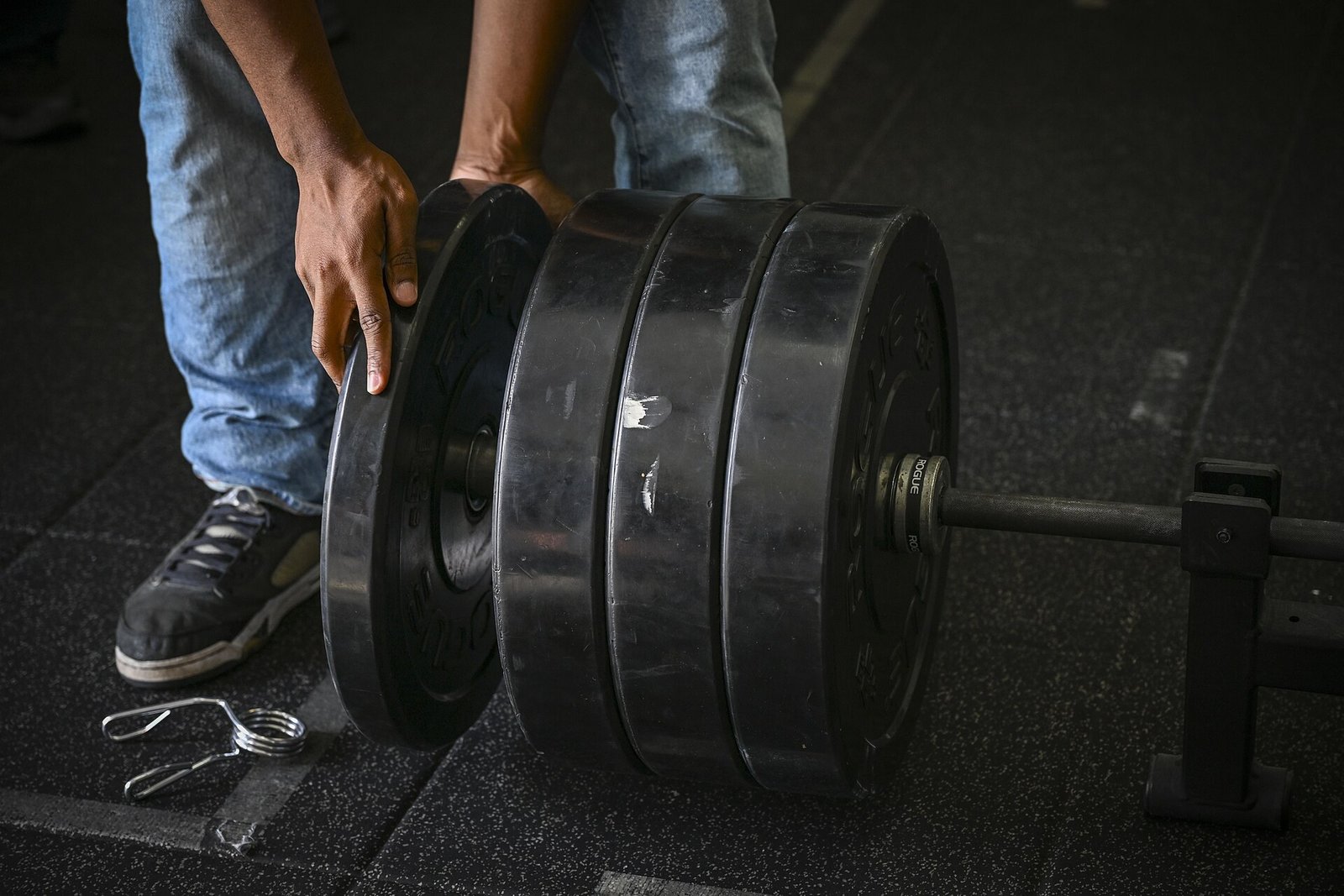
Photo: Wikimedia Commons
Colour coding
Four sizes of near-identical steel discs are easy to confuse, especially between sets. Colour coding (EVERYMATE, LoGest, 44SPORT, and Micro Gainz’s colour option) removes that guesswork.
If you buy an all-black set, label it yourself — a paint pen or coloured tape on each size saves loading mistakes for the life of the set.
Keep the set together. A bag (included with Micro Gainz) or a small box stops quarter-pound plates vanishing into a gym bag, where they are useless.
Set vs pairs
Buy the full set, not a single pair, unless you know exactly which increment you need. A single pair of 0.5 lb plates gives you one jump size; a full set gives you a ladder.
The exception is dumbbell plates, where 2-piece and 4-piece Yes4All sets are sold separately — two pieces microload one dumbbell, four microload a pair.
One more honest note: fractional plates will not fix a programme that has no progression plan, a diet that does not support recovery, or technique that breaks down under load. They are a fine-tuning tool for a programme that is otherwise working.
Using fractional plates safely
Seat every small plate fully on the sleeve and lock your collars before lifting — small plates slide more easily than heavy ones, and a sliding plate unbalances the bar.
Never load fractional plates outside a collar unless the maker’s instructions say the set is designed for it; the default is inside, like any other plate.
Count both sides before unracking. A 0.25 lb plate is small enough to miss and big enough to matter when the bar is heavy.
If you have an injury, or pain that keeps coming back, talk to a clinician or physiotherapist before pushing a stalled lift with smaller jumps. This guide is general information only, not medical advice.
Frequently Asked Questions
How much weight do fractional plates actually add?
As little as 0.5 lb to the bar in total — one 0.25 lb plate on each side. A full 0.25–1 lb set gives total jumps from 0.5 lb up to 5 lb, in half-pound steps.
Do fractional plates fit my barbell?
Almost certainly, if your bar is Olympic (2-inch sleeves). Every barbell set here is 2-inch. If your bar is a 1-inch standard bar, check for a 1-inch version before ordering.
Will micro plates help me break a plateau?
They help when the plateau is caused by jumps that are too big — the classic case is a press stuck on 5 lb jumps. They do not help when the real problem is programming, recovery, sleep, or technique, and they never replace any of those.
Are calibrated plates worth it?
For most lifters, no — a standard steel set is accurate enough for training. Calibrated plates (Micro Gainz, ±5 grams) matter most for lifters near competitive limits, or anyone who wants the tightest stated accuracy available.
Can I use fractional plates on dumbbells?
Not barbell plates — they do not fit dumbbell handles. Use clip-on dumbbell plates like the Yes4All pick here, and check handle compatibility first.
How do I stop losing such small plates?
Keep them in one bag or box, in one place, and count them back after every session. A set that lives loose in a gym bag will lose its smallest plates first — which are exactly the ones you bought it for.
Our Pick in One Line
If you want one answer: the Micro Gainz calibrated set is the best all-round buy because its full 0.25–1 lb ladder and ±5 gram stated tolerance cover every small jump a stalled lift needs — but if colour coding matters more than calibration, the EVERYMATE set gives you the same ladder for less fuss.
For the rest of your plate setup, see our bumper plates guide and our barbell collars guide, and for dumbbell training, see our dumbbells guide.
As an Amazon Associate, we earn from qualifying purchases made through links on this page, at no extra cost to you.
This guide is research-based: we compared verified buyer reviews and manufacturer specifications, and we did not buy or hands-on test these products. Prices and availability change, so check the listing before ordering. The training information here is general information only, not medical advice — if you have an injury or recurring pain, talk to a clinician first.